 +447413083355































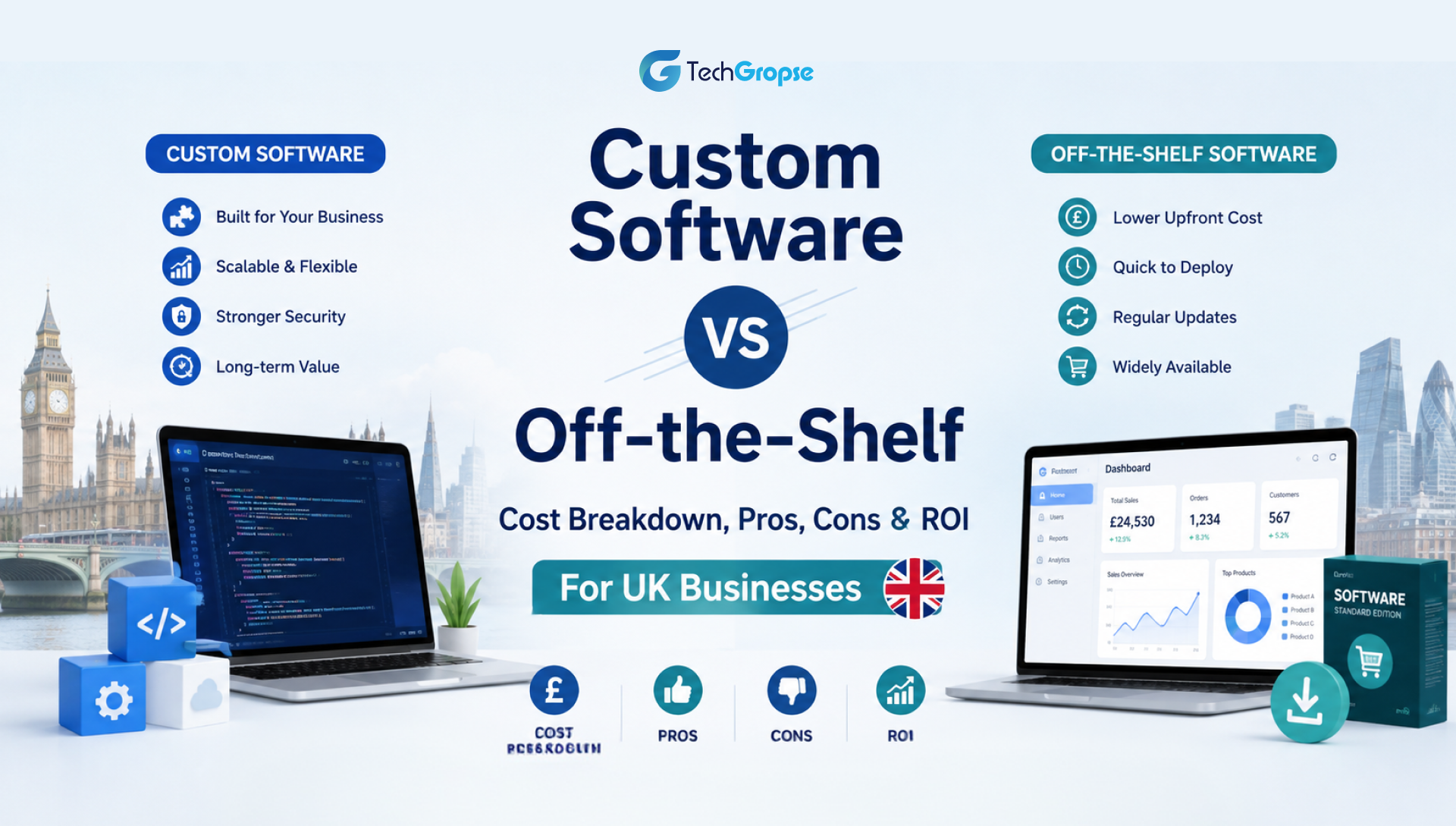
Every growing British enterprise inevitably reaches a critical digital crossroad: operational scale begins to outpace existing tooling, and manual workarounds start costing hundreds of productive hours. When evaluating custom software vs off-the-shelf UK strategies, leadership teams face a persistent tension between speed and control. Commercial off-the-shelf software offers an immediate, plug-and-play launchpad, whereas bespoke development delivers a purpose-built system designed to anchor your long-term competitive advantage.
The dilemma typically starts with a standard SaaS subscription intended to solve an immediate operational bottleneck. At first, the software performs as expected. Teams find themselves maintaining secondary spreadsheet workarounds, jumping between disconnected applications, and bending established business practices simply to fit within the constraints of third-party architecture.
The true cost of this compromise is measured directly on the balance sheet. Off-the-shelf software promises predictable monthly spending, yet the underlying economics tell a different story. Industry findings from Zylo’s SaaS Management Index reveal that organisations waste 46% of their software expenditure on dormant or surplus user seats.
When combined with software price inflation running at 16.4% per annum according to Vertice, enterprise subscription models quickly shift from a flexible utility to an escalating operational overhead. For UK businesses scaling their headcounts, recurring seat fees and paid integration add-ons often outpace the long-term capital investment required to build and own proprietary architecture.
Choosing your next technological foundation requires looking beyond the initial subscription invoice to evaluate the true 5-year Total Cost of Ownership (TCO), operational ROI, and the value of proprietary assets. Whether your strategic priority is to stop the haemorrhaging of wasted subscription spend or to build dedicated intellectual property that cements your market differentiation, making the right call demands clear-eyed financial analysis. Read on for a complete UK-focused breakdown of software development costs, side-by-side pros and cons, and an executive framework to determine whether to build or buy.
Key Takeaways
In the debate of custom software vs off-the-shelf UK solutions, buy off-the-shelf for standard, commoditised tasks needing immediate rollout. Build custom software when proprietary workflows drive your competitive advantage, SaaS seat costs become excessive, or strict UK data sovereignty is mandatory.
- Off-the-shelf has low upfront costs but perpetual, compounding per-seat fees (£30–£250+/user/month). Custom software requires an upfront capital investment (£11k–£110k+) with zero recurring licence fees.
- Off-the-shelf deploys in days or weeks; bespoke development requires a structured 3-6+ month build cycle.
- Off-the-shelf is leased software with vendor lock-in risks; custom software is 100% proprietary code and an enterprise balance-sheet asset.
- Off-the-shelf relies on vendor cloud configurations; custom builds allow dedicated UK hosting (AWS London/Azure UK South) for strict UK GDPR and FCA/NHS compliance.
- Off-the-shelf forces your team into generic industry templates; custom software aligns precisely with your unique operational workflows.
What Is Bespoke (Custom) Software vs. Off-the-Shelf?
To make an informed technological investment, you must first understand what you are actually paying for under the hood. At a high level, the debate of off-the-shelf vs custom software business models comes down to a choice between renting a pre-built digital utility or constructing a dedicated digital asset. Both approaches serve distinct commercial purposes, yet they function on entirely different technical and financial principles.
Understanding Commercial Off-the-Shelf Solutions
Vendors primarily deliver Commercial Off-the-Shelf software today as Software-as-a-Service (SaaS) to serve the broadest possible audience. Vendors design these ready-made products to solve universal operational tasks across multiple industries using a single, unified codebase.
From an architectural standpoint, these solutions operate on a multi-tenant cloud model. This means your business shares underlying infrastructure, databases, and server computing power with thousands of other organisations, separated only by software permissions.
For standard business functions, this model works remarkably well. In the UK market, typical examples include:
- Accounting and Bookkeeping: Standardised platforms like Xero or QuickBooks that comply seamlessly with HMRC’s Making Tax Digital (MTD) rules out of the box.
- Basic CRM & Sales Principles: Mass-market tools like HubSpot or Zoho for standard lead tracking.
- Team Collaboration: Everyday productivity suites such as Microsoft 365, Google Workspace, and Slack.
Because the vendor must cater to tens of thousands of different companies, this software prioritises common denominators. You gain access to a functional tool within minutes, but you also inherit fixed design constraints, rigid database structures, and feature roadmaps that you have zero power to influence.
Defining Bespoke (Custom) Software
Bespoke software is custom-engineered from the ground up to match the precise operational mechanics, compliance requirements, and commercial goals of your enterprise. Instead of moulding your operations around an existing template, the software is constructed around how your team actually works.
Architecturally, custom solutions are built as dedicated, single-tenant systems or decoupled microservices. You dictate the data structures, the API protocols, the hosting locations, and the user interface. Crucially, your organisation holds 100% ownership of the proprietary intellectual property (IP) and underlying source code.
Bespoke development shines where off-the-shelf software hits an operational brick wall:
- Proprietary Logistics & Supply Chain Engines: Multi-depot routing algorithms tailored to regional UK transport networks and warehouse layouts.
- Complex FinTech & Wealth Management Portals: Systems integrating legacy core banking engines with custom Open Banking APIs under strict FCA guidelines.
- Unified Business Operations (ERP): Centralised platforms that merge inventory, custom manufacturing lines, client billing, and field service management into one seamless dashboard without messy third-party plugins.
While evaluating the custom software development cost UK market rates demand, it helps to view bespoke development as a capital investment. You are not simply buying software functionality; you are building an exclusive operational asset that lives directly on your balance sheet.
Custom Software vs Off-the-Shelf Solutions: Pros and Cons
Choosing between renting software and owning your digital infrastructure involves distinct commercial trade-offs. To understand whether is custom software worth it UK enterprises must weigh operational agility against upfront capital allocation. Explore the honest, strategic breakdown of the operational, financial, and technical strengths and weaknesses of each model.
Custom Software: The Strategic Asset
Bespoke software turns technology from an operational expense into a company-owned asset. It offers complete freedom, but it also places full responsibility on your technical roadmap.
The Advantage (Pros)
- 100% Workflow Alignment: The architecture mirrors your unique business processes exactly. There is no need for manual spreadsheet workarounds, duplicate data entry, or redundant operational steps.
- Full Intellectual Property (IP) Ownership: Your business retains complete legal ownership of the source code, databases, and UI/UX design. This converts software spend into an equity-building balance sheet asset that increases company valuation.
- Zero Licensing Bloat & Scalable Economics: Add ten, a hundred, or a thousand users without paying an extra penny in seat licenses. Your marginal software cost per employee drops toward zero as you scale.
- Seamless Legacy & Third-Party Integration: Purpose-built APIs connect directly to your existing UK banking portals, warehouse machinery, or bespoke databases without relying on expensive middleware.
- Dedicated Security & Sovereign Compliance: Single-tenant hosting allows complete control over data residency. This ensures seamless compliance with the UK GDPR, Data Protection Act 2018, and sector benchmarks like NHS DSPT or FCA operational resilience mandates.
- Direct Competitive Moat: Because your competitors cannot buy or replicate your bespoke system off the shelf, your proprietary workflows remain an exclusive commercial advantage.
The Disadvantages (Cons):
- Substantial Initial Capital Outlay: Building custom software requires a committed upfront investment. While evaluating your software development cost comparison UK, upfront figures typically start between £25,000 and £100,000+.
- Extended Time-to-Market: From discovery, UI/UX architecture, and sprint cycles to QA testing, bespoke builds generally require 3 to 6+ months before production deployment.
- Ongoing Maintenance Accountability: Your business is responsible for hosting infrastructure, OS version updates, security patches, and periodic feature enhancements, typically budgeting 15-20% of the build cost annually.
- Internal Resource Demand: Successful custom builds require active collaboration. Your internal project owners must invest time in sprint reviews, user acceptance testing (UAT), and requirements scoping.
Off-the-Shelf Software: The Turnkey Utility
Commercial off-the-shelf software functions like a serviced utility. It delivers immediate convenience and low initial friction, but places clear boundaries around your autonomy.
The Advantages (Pros):
- Instant Deployment & Rapid Speed-to-Value: Accounts can be configured and deployed within days or weeks, making it ideal when you need to resolve an immediate operational gap.
- Lower Initial Financial Barrier: Negligible upfront setup fees make it accessible for early-stage companies operating with limited starting capital.
- Vendor-Managed Upkeep & Infrastructure: The SaaS vendor shoulders full responsibility for server maintenance, standard bug fixes, database hosting, and security patches.
- Continuous Feature Ecosystem & Proven Stability: Established platforms benefit from millions of active users, ensuring stable codebases, regular out-of-the-box feature releases, and broad online documentation.
- Predictable Short-Term OpEx: Monthly or annual subscription invoicing provides clear short-term predictability for departmental cash flow planning.
The Disadvantages (Cons):
- The “Feature Ceiling” & Rigid Constraints: When your workflows outgrow standard templates, off-the-shelf software cannot be customized past vendor limits. Teams end up building disconnected manual processes to bridge the gaps.
- Compounding Perpetual Licensing Costs: Monthly per-user subscription fees scale relentlessly with headcount. As your team grows, the cost of ownership software UK benchmarks show that SaaS seat fees quickly eclipse the cost of bespoke development.
- Vendor Lock-in & Pricing Exposure: You are subject to sudden subscription price hikes, feature tier reshuffling, or abrupt product deprecation with little to no leverage. Migrating away from a proprietary SaaS ecosystem is complex and costly.
- Shared Threat Surface: Multi-tenant architecture exposes your data pipeline to broader vendor vulnerabilities, making it an attractive target for automated mass-exploitation attacks.
- Zero Commercial Differentiation: Because your direct competitors have access to the exact same off-the-shelf tools and feature sets, the software providers have zero proprietary market advantage.
Summary Checklist: Which Model Matches Your Priorities?
| Strategic Consideration | Choose Custom Software If... | Choose Off-the-Shelf If... |
|---|---|---|
| Operational Workflow | Your process is proprietary, complex, or core to how you win clients. | Your process is standard across the industry (e.g., standard payroll or email). |
| Budget Horizon | You have capital to invest upfront to eliminate recurring seat fees long-term. | You prefer smaller monthly OpEx payments without initial capital expenditure. |
| Timeline | You can commit 3–6 months to engineer a tailored solution. | You need an operational tool running within the next 14–30 days. |
| Data & Compliance | You require full control over UK data residency and custom security protocols. | Standard third-party cloud compliance and shared security models are sufficient. |
| Enterprise Asset Value | You want to build proprietary IP that enhances the valuation of your business. | You are comfortable leasing software tools with no residual asset value. |
The 2026 UK Cost Breakdown: Bespoke vs. Off-the-Shelf
When evaluating custom software vs off-the-shelf UK solutions, upfront pricing rarely tells the entire financial story. Off-the-shelf SaaS platforms present an attractive, low-barrier entry point through monthly subscriptions. Conversely, bespoke software demands an upfront capital allocation that often requires board-level sign-off.
To make an accurate commercial appraisal, UK decision-makers must evaluate transparent development benchmarks against the compounding costs of commercial software licensing.
Custom Software Development Cost in UK
Scope, third-party API dependencies, and regulatory requirements directly determine the custom software development cost UK enterprises pay. Based on current UK market rates (£50 to £110+ per hour / £400 to £850+ day rates), bespoke development typically falls into three clear investment tiers:
Basic MVP or Internal Workflow Tool: £11,000 – £18,350
- Scope: Single-purpose business applications designed to digitise manual spreadsheets or automate specific internal processes.
- Key Features: Role-based access control (RBAC), simple database architecture, essential reporting dashboards, and foundational cloud hosting setup.
- Timeline: 8 to 12 weeks
Mid-Complexity Business Platform: £18,350 – £110,100
- Scope: Multi-department operational platforms built to handle end-to-end commercial operations, customer engagement, or field service dispatching.
- Key Features: Tailored workflow automation, custom UI/UX design systems, integration with UK payment gateways and accounting tools alongside automated data pipelines.
- Timeline: 3 to 6 months
Complex Enterprise & Regulate Architecture: £110,100
- Scope: Large-scale, high-concurrency platforms operating under strict regulatory oversight such as UK GDPR, FCA Open Banking, or NHS DSPT guidelines.
- Key Features: Microservices infrastructure, bespoke algorithmic routing, legacy database refactoring, multi-platform deployment (web, iOS, Android), and automated failover security.
- Timeline: 6 to 9+ months
The Hidden Costs of Off-the-Shelf SaaS Solutions
A thorough software development cost comparison UK review requires exposing the quiet expenses lurking behind “affordable” monthly SaaS subscriptions. While initial setup invoices look modest, recurring overheads accumulate rapidly across three primary areas:
- Compounding Per-Seat Tier Traps: Most commercial SaaS providers lock essential functionality (such as custom roles, single sign-on/SSO, audit logs, and dedicated API access) behind “Enterprise” tiers. A tool starting at £35 per user per month easily escalates to £150 – £280 per seat once required enterprise features are unlocked. For a 50-to-100-person organisation, annual licensing alone frequently exceeds £90,000 to £180,000.
- Premium Connector & Middleware Fees: Off-the-shelf applications rarely connect natively to bespoke databases or internal tools. Bridging these gaps forces organisations to licence dedicated enterprise integration middleware or pay recurring surcharges for premium API calls, introducing further ongoing overheads.
- Third-Party Implementation & Consulting Invoices: Deploying enterprise commercial off-the-shelf systems typically mandates external systems integrators. Setup fees, workflow re-engineering, employee retraining, and data sanitisation routinely cost between £15,000 and £60,000+, all before your team logs a single productive hour.
Custom Software vs Off-the-Shelf Solutions: The ROI Breakeven Curve
When evaluating whether custom software is worth it, UK leadership teams often fall into the trap of short-term cash flow comparisons. Off-the-shelf software looks deceptively economical on day one because there is minimal upfront capital outlay. However, looking at the full total cost of ownership of software UK benchmarks over a 3 to 5-year operating horizon reveals a completely different financial reality.
Bespoke development acts as an initial capital asset, whereas commercial SaaS acts as a compounding operational tax. To understand your true return on investment, you must analyse the realistic lifecycle costs where these two software models intersect.
The 5-Year TCO Comparison: 100-User Enterprise Model
To illustrate the long-term financial trajectory, consider a typical mid-sized UK business scaling from 100 internal users.
- Scenario A (Off-the-Shelf SaaS Stack): 100 users on an enterprise-tier business suite at £120/seat/month (including necessary paid connectors and audit logs), assuming a modest 10% annual SaaS price increase and a standard £15,000 initial onboarding/integration fee.
- Scenario B (Bespoke Development Build): A dedicated platform engineered at a custom software cost UK benchmark of £90,000 upfront, combined with a 15% annual maintenance, hosting, and SLA support budget (£13,500/year).
The Breakeven Crossover Analysis: Where Bespoke Software Delivers Dominant ROI
The mathematical reality of software licensing creates a predictable financial inflection point:
- The Short-Term Advantage (Months 1-12): Off-the-shelf software offers faster cash flow agility early on. If your operational horizon is under 18 months, SaaS avoids high initial expenditure.
- The Breakeven Crossover Point (Year 2 to Year 3): As the initial custom software development cost UK amortises across the business, the bespoke system reaches parity with cumulative SaaS subscription invoices.
- The Compounding Asset Phase (Year 3-5+): By Year 3 and beyond, commercial SaaS costs accelerate aggressively due to per-seat inflation and headcount expansion. Meanwhile, custom software costs drop to a flat maintenance baseline. Your enterprise retains 100% of the proprietary IP, effectively freeing hundreds of thousands of pounds in cash flow that can be reinvested into commercial expansion.
| Operating Horizon | Off-the-Shelf SaaS (100 Seats + Add-ons) | Custom Software Build (£90k Upfront) | Net Enterprise Savings |
|---|---|---|---|
| Year 1 | £159,000 (£144k licences + £15k setup) | £103,500 (£90k build + £13.5k maintenance) | +£55,500 |
| Year 2 | £158,400 (with 10% SaaS price inflation) | £13,500 (predictable maintenance) | +£144,900 |
| Year 3 | £174,240 (compounding per-seat cost) | £13,500 (predictable maintenance) | +£160,740 |
| Year 4 | £191,664 (compounding per-seat cost) | £13,500 (predictable maintenance) | +£178,164 |
| Year 5 | £210,830 (compounding per-seat cost) | £13,500 (predictable maintenance) | +£197,330 |
| Total 5-Year TCO | £894,134 | £157,500 | £736,634 Saved |
When weighing these financial models and asking whether custom software is worth it, businesses find that bespoke development pays for itself multiple times over simply by eliminating the perpetual subscription overhead of growing teams.
Renting vs Owning: Practical Financial and Tax Wins for UK Businesses
When calculating return on investment, the decision comes down to a simple commercial principle: are you renting a utility or building a company asset? Paying for off-the-shelf software is like renting office space; the moment you stop paying monthly subscriptions, you lose access, and the money spent is gone forever. In contrast, investing in your custom software development cost UK means you are buying real estate. It creates concrete financial and tax benefits that make your business more profitable and valuable over time.
- Turn Software Costs into a Valuable Company Asset: When you pay monthly SaaS subscriptions, that money disappears as a pure operating expense. But when you build custom software, the codebase becomes proprietary company property that belongs to your business. This directly increases your company’s balance-sheet valuation, making your business significantly more attractive if you ever seek growth investment, bank funding, or plan an exit.
- Cash Back Through HMRC R&D Tax Relief: Many British business owners do not realise that creating bespoke platforms often qualifies for UK R&D Tax Relief. If your custom software project solves technical hurdles or creates new operational workflows, you can claim back a healthy portion of development and contractor costs directly against your Corporation Tax bill.
- Immediate Tax Deductions via Annual Investment Allowances: The UK government allows companies to offset qualifying capital spend on business technology against their taxable profits in the very first year. This means a substantial part of your initial custom software development cost UK investment can reduce your immediate tax liability.
- Immunise Your Business Against Sudden Price Rises: When you rely completely on foreign SaaS platforms, you are entirely at the mercy of sudden contract price hikes, tier restructuring, and unfavourable currency exchange rates. By establishing your cost plan upfront, you protect your business margins, keep overheads strictly predictable, and remove vendor dependency for good.
Renting software through endless subscriptions drains cash month after month with zero equity to show for it. Building custom software turns your technology spend into a tax-efficient, company-owned asset that protects cash flow and scales directly with your enterprise.
Decision Framework: When to Build vs When to Buy
Navigating the choice between custom software vs off-the-shelf UK solutions comes down to a clear operational audit: where does the software sit within your business model?
Technology investments should either automate routine administrative overhead or actively power your competitive moat. When comparing an off-the-shelf vs custom software business strategy, use the following executive decision framework to guide your investment.
Choose Commercial Off-the-Shelf Software If:
Buying a ready-made SaaS solution is the smarter commercial path when convenience, immediate utility, and standardisation outweigh the need for customisation:
The Operational Process Is a Generic Commodity: Standard business operations, such as HMRC-compliant payroll (e.g., BrightPay), transactional email distribution (e.g., Mailchimp), or basic team chat, work the same across every company. Rebuilding these tools from scratch adds zero commercial differentiation.
Rapid Deployment Is Mandatory (<30 Days): If your organisation needs an immediate tool to plug an operational gap next week, off-the-shelf software allows you to register accounts, import baseline contacts, and go live almost instantly.
Cash Flow Favours Low-Commitment Monthly OpEx: Early-stage businesses or teams testing a new operational process often benefit from paying modest monthly subscription fees without committing upfront capital.
Standard Workflows Require No Specialisation: If your team can operate smoothly within pre-set templates, validation fields, and out-of-the-box dashboards without relying on offline spreadsheets, commercial SaaS delivers sufficient utility.
Choose Custom Software Development If:
Investing in a bespoke platform becomes the highest-ROI move when off-the-shelf tools begin restricting business growth or inflating recurring overheads:
The Software Delivers Your Primary Market Differentiation: If the tool interacts directly with how you price, deliver, or service your clients, off-the-shelf tools level the playing field for your competitors. Bespoke software keeps your proprietary operational methods completely exclusive.
Workflows Are Too Complex for Standard Templates: When teams spend hours bridging SaaS software gaps with nested Excel sheets, manual data transfers, and disjointed tools, bespoke development eliminates the friction by automating the exact end-to-end workflow.
Per-Seat Licensing Is Eroding Operating Margins: When asking is custom software worth it UK directors find their answer the moment headcount expands past 30 to 50 users. If compounding monthly subscription fees and tier upgrades start costing £50k–£100k+ annually, building a company-owned platform permanently caps software costs.
Strict Data Control and UK Hosting Are Non-Negotiable: When managing sensitive enterprise assets under UK GDPR, FCA guidelines, or NHS DSPT frameworks, custom single-tenant architecture guarantees full control over data pipelines and sovereign UK cloud infrastructure.
The 80/20 Rule: The Hybrid Approach
For many expanding British enterprises, the winning technological blueprint is a pragmatic hybrid model:
- Rent the Commodity (80%): Keep commercial SaaS platforms for standard, non-differentiating operational tasks (accounting, standard calendar booking, team communications).
- Build the Core Asset (20%): Invest your capital into bespoke custom software for the central engine that runs your primary operations, customer portal, or supply chain. Connect everything smoothly via custom APIs.
This hybrid approach allows you to deploy capital efficiently: protecting cash flow while ensuring that your core commercial operations remain scalable, secure, and entirely under your control.
Final Thoughts
Deciding between custom software development services and off-the-shelf SaaS comes down to a clear business reality: renting software drains cash month after month, while building custom architecture creates a long-term company asset. Off-the-Shelf tools work well for generic tasks like payroll or chat. But when software powers your core operations, proprietary workflows, or client delivery, relying on rigid templates and per-seat fees will eventually cap your commercial growth.
While the initial custom software development cost in the UK benchmark requires an upfront commitment, it consistently delivers superior 5-year ROI by eliminating licensing bloat, boosting operational efficiency, and ensuring strict UK data sovereignty. Stop adapting your business to fit someone else’s software limitations. Partner with expert engineers to build dedicated, high-performance systems designed around your exact operational goals.

Frequently Asked Questions
In the UK, bespoke software development typically ranges from £11,000 to £110,000+, depending on complexity. A basic internal workflow tool or MVP generally costs between £11,000 and £18,350; mid-complexity platforms (like custom CRMs or ERPs) fall between £18,350 and £110,000, while complex, regulated enterprise architectures scale beyond £110,000.
Yes, primarily because bespoke provides dedicated, single-tenant hosting and an isolated codebase. Unlike multi-tenant SaaS, where thousands of companies share the same database and cloud infrastructure, custom builds eliminate shared-server vulnerabilities. They also allow you to host data strictly within UK regions (such as AWS London or Azure UK South) to maintain full UK GDPR compliance.
Most custom business software projects take between 2 to 9 months to go live:
Basic MVPs & internal tools: 8 to 12 weeks.
Mid-scale operational platforms: 3 to 6 months.
Complex, multi-platform enterprise systems: 6 to 9+ months.
The exact timeline depends on architectural scope, custom API integrations, and the depth of user testing required.
Yes. If your custom software project resolves genuine technical uncertainties, builds novel algorithms, or creates bespoke integrations that did not previously exist off the shelf, the project often qualifies for HMRC R&D Tax Relief. Eligible companies can claim back a portion of their qualifying development and contractor costs against Corporation Tax.
As long as your initial contract guarantees 100% intellectual property (IP) and source code ownership, you retain full control over your software. Professional development agencies build on standard, well-documented frameworks, complete with code repositories and deployment pipelines. This makes it straightforward for your in-house team or a new technical partner to take over ongoing maintenance without starting from scratch.

Hello all, Aman Mishra has years of experience in the IT industry. His passion for helping people in all aspects of mobile app development. Therefore, he writes several blogs that help the readers to get the appropriate information about mobile app development trends, technology, and many other aspects. In addition to providing mobile app development services in the UAE, he also provides software development, AI development, maintenance & support services, and UI/UX, and integration service to businesses of all sizes.