Key Takeaways
- Importance of having NHS compliance for a business in Healthcare mobile app development in UK. Why NHC compliance is a strategic win for an app service provider.
- Healthcare mobile app development process in UK – 2026 that will help businesses grow faster.
- The cost of building a compliant Healthcare mobile application in UK and what factors increase it.
- How to choose a Healthcare mobile app development service that helps you build solutions that scale.
The UK’s expenditure was £317 billion, which shows that the UK government is quite serious about the health of its citizens. The UK healthcare system is no longer transforming digitally. It is already running on a scaled digital foundation.
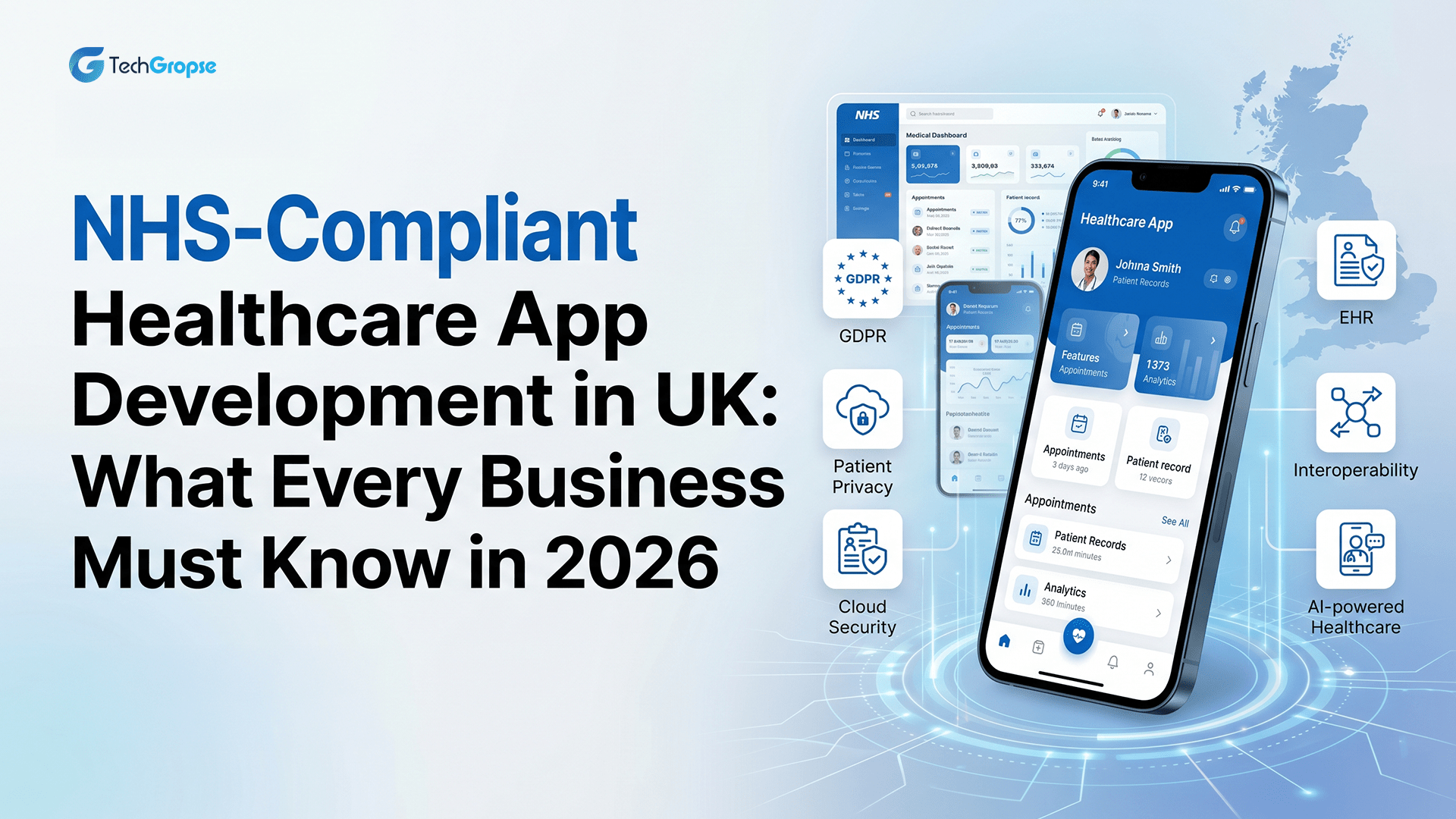
The UK-based business wants to do an NHS-compliant healthcare app development in UK. It is done to ensure that they want to operate inside one of the largest, most regulated, and most trusted healthcare systems in the world.
Building an NHS-compliant application is not straightforward. It demands strict adherence to clinical, security, and interoperability standards defined by the NHS UK, alongside robust data protection and safety requirements.
This guide is designed for decision-makers, startup founders, product managers, CTOs, and digital agencies working at the intersection of healthcare and technology. It will cover the following:
- Importance of NHS compliance
- The app development process
- How to choose the right company.
Ready to explore more with us? Let’s dive in.
Why NHS compliance is a strategic commercial advantage
NHS compliance refers to meeting the rigorous clinical, data security, interoperability, and procurement standards set by the National Health Service. For healthtech companies and suppliers, achieving this compliance is far more than a regulatory checkbox. It signals trustworthiness, technical maturity, and readiness to operate within one of the world’s most complex healthcare ecosystems.
DSP Toolkit as a Trust Signal
By obtaining the certification of the NHS Data Security and Protection (DSP) Toolkit, solid data governance and cybersecurity practices are evidenced. This not only meets the requirements of the NHS procurement but is also an effective trust signal to the private healthcare clients, insurers, and the international health systems that have the same standards.
Quick Sales Processes as Pre-Approved.
Listing on NHS-approved frameworks reduces the procurement times significantly. Customers are able to deal directly with suppliers without protracted tender procedures, so that compliant suppliers can seal a deal more quickly, cut off sales overhead, and gain a quantifiable conversion benefit on competitors.
Interoperability Unlocks Scalability
Interoperability standards, such as NHS interoperability standards, including FHIR, HL7, and NHS login, imply that your product will be interoperable with any trust, ICBs, and GP systems. This radically reduces the cost of scaling to a variety of NHS organisations. It also ensures your solution is much more adhered to, and difficult to push off by competitors.
Virtue That Crosses Borders
Compliance in the NHS has a huge reputational value across borders. The NHS standards are actively sought as a quality benchmark by health systems in the Middle East, Southeast Asia, and beyond. Those suppliers that are able to prove NHS compliance have a much easier time finding entry into export markets, securing international tenders, and gaining investor confidence.
The NHS-compliant Healthcare App development process in UK for 2026
In 2026, for NHS-compliant healthcare app development in UK a company needs to go beyond just coding. It involves aligning with clinical safety requirements, data protection laws, interoperability standards, and security frameworks from the very first stage of product design.
Phase 1: Discovery & Classification
Any NHS-aligned app starts with an accurate definition. The stage aims at defining the purpose of the application, whether it is a medical device, and a Data Protection Impact Assessment (DPIA). This is accompanied by stakeholder mapping to align clinical, technical, and regulatory expectations at the beginning, which minimizes the risks of downstream compliance.
Phase 2: Compliance Architecture
The compliance framework is in place after the foundation has been laid. It involves the appointment of a Clinical Safety Officer, starting the DCB0129 hazard log, and readiness to receive the certification of Cyber Essentials. Meanwhile, the data security and protection toolkit (DSPT) readiness is evaluated, so that the architecture of the application corresponds to the requirements of NHS data governance and security.
Phase 3: Mobile App Development
The implementation of development is done with consideration of compliance throughout. A FHIR-first API strategy will guarantee that it is interoperable with NHS systems, and UK-only data hosting will meet data residency needs. It is designed with early accessibility following the WCAG 2.2 AA guidelines and has powerful role-based access control measures to ensure high data security and user control.
Phase 4: Clinical Validation & Testing
The application is subjected to stringent validation before it is deployed. This encompasses user testing involving clinical users to enable practical usability, completion of the clinical safety case, and formal penetration testing by CREST-certified or Tigerscheme-certified providers. Moreover, there is a self-assessment of a DTAC to determine compliance in the following benchmarks: security, clinical safety, and interoperability.
Phase 5: NHS App Library / Trust Procurement.
Once validated, the application is submitted and procured. This includes preparing the documentation of the NHS App Library or individual Trust onboarding processes. The usual period of assessment is between 8 and 16 weeks, where compliance, usability, and security are tested. It is important to identify the most popular rejection causes at this point so that chances of approval can be enhanced.
Phase 6: Post-Launch Compliance & Monitoring
Compliance is not a one-time task but a continuous one. DSPT submissions annually are needed to uphold data security standards, and the ongoing monitoring under DCB0160 is needed to ensure clinical safety in real-world applications. There should be frequent DTAC reviews and well-spelled incident response guidelines to ensure the compliance and continuity of trust in the NHS ecosystem.
NHS-compliant Healthcare Mobile App Development Cost
Assessing cost is one of the most important points on which many healthcare businesses, startups, and decision makers rely. The following table helps a business ascertain the revenue outcome and make an informed decision.
[table “393” not found /]What Leads to Cost Maximization of NHS-Compliant Healthcare App Development in UK
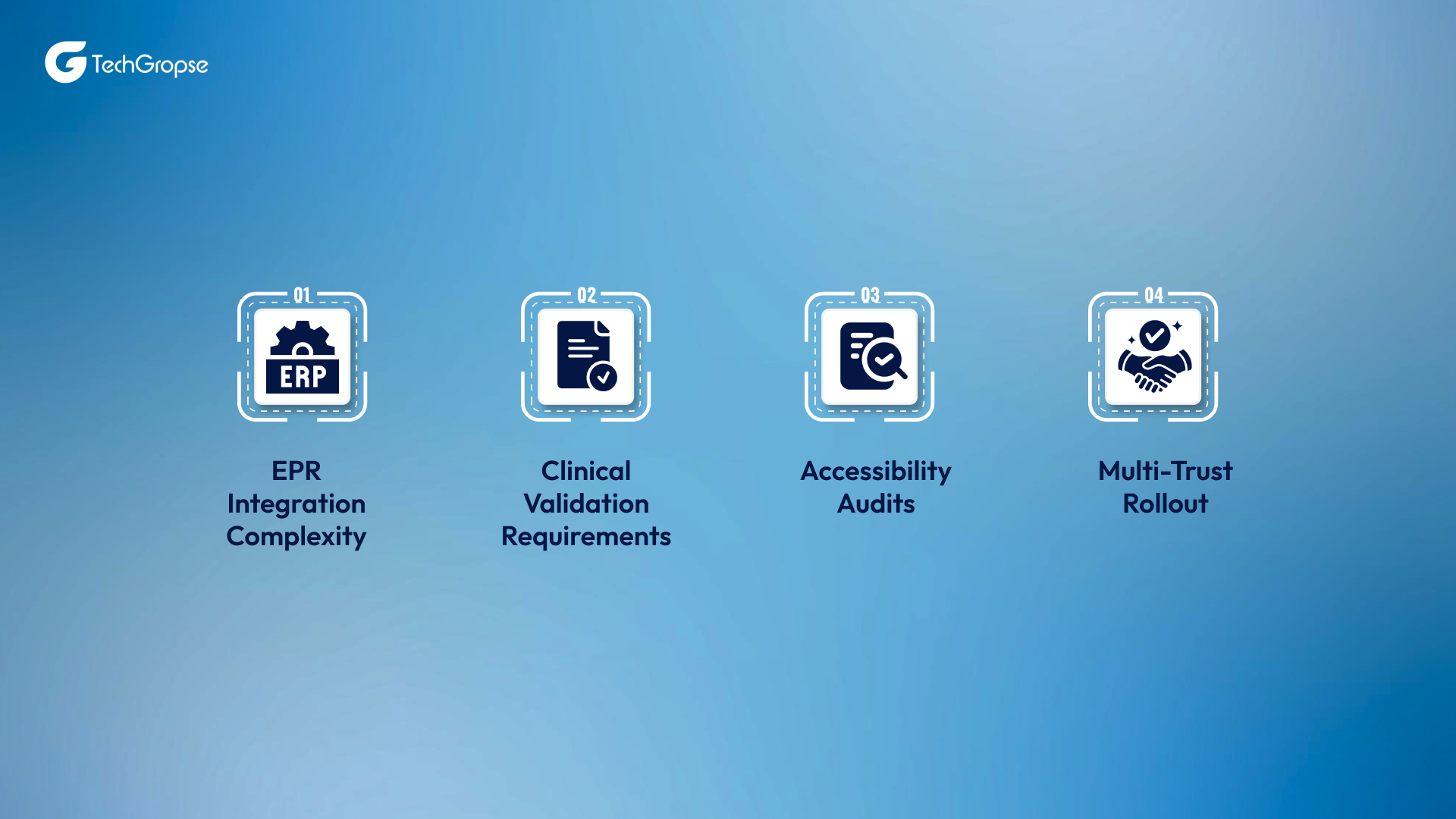
NHS-compliant healthcare app development in the UK becomes cost-intensive due to the layered complexity of clinical, technical, and regulatory requirements.
EPR Integration Complexity
Connecting with Electronic Patient Record (EPR) systems greatly raises the cost of development because of different hospital designs, old infrastructure, and stringent interoperability criteria. To achieve real-time, reliable data transfer of clinical data, each NHS Trust might need to be integrated, undergo a lot of testing, and be guaranteed of secure data mapping.
Clinical Validation Requirements
Clinical validation is an additional expense in that healthcare applications need to prove their safety, accuracy, and effectiveness prior to implementation. This entails clinical specialist reviews, safety case documentation, and trial-and-test in real world contexts to guarantee that the app is up to NHS clinical governance and risk management standards.
Accessibility Audits
The compliance of accessibility adds a cost burden due to the need to have comprehensive audits against WCAG standards to determine that it is usable by patients with disabilities. To ensure the strict NHS accessibility requirements, developers have to provide support to screen readers, contrast optimization, keyboard navigation, and usability testing, which can take several iterations to achieve the desired outcome.
Multi-Trust Rollout
Application scaling in a number of NHS Trusts is a very expensive undertaking that will incur different costs because of varying IT systems, governance approvals, and deployment environments. Every Trust might need configuration and compliance assessments, onboarding, and a large-scale rollout, which is a complicated and resource-intensive stage of delivery.
How to choose the right NHS app development partner
Developing an NHS-compliant healthcare mobile app in the UK becomes cost-intensive. It is done due to the layered complexity of clinical, technical, and regulatory requirements defined by NHS England. If you choose the incorrect partner, then it will not develop the blog as planned.
The following 7 questions help you know how to select the best partner for mobile app development in UK in 2026:
1. Do you have proven experience building for the NHS specifically?
General healthcare or app development experience is not enough. Ask for case studies in app development where compliance is followed.
2. Are you DSP Toolkit compliant and DTAC-assessed?
The Digital Technology Assessment Criteria (DTAC) and DSP Toolkit are non-negotiables for NHS deployment. A credible partner should already hold or actively maintain these accreditations, not be learning about them after you’ve engaged them.
3. What are your NHS interoperability standards?
Be particular regarding their practical experience with FHIR, HL7, NHS login, and GP Connect. Not only will a good partner be familiar with the acronyms, but they will also be able to take you through the way they have applied these in real projects and how they have overcome the integration issues.
4. How is your clinical safety process?
NHS apps need a Clinical Safety Management File and must be in accordance with DCB0129 (to manufacturers) and DCB0160 (to deploying organisations). Enquire about whether they have an in-house qualified Clinical Safety Officer and how clinical risk is addressed in the course of the development lifecycle.
5. What is your attitude towards NHS procurement and commercial arrangements?
An experienced partner will have knowledge of G-Cloud, the NHS App Library submission process, and how the ICB and trust procurement committees work. Unless they are able to communicate fluently on commercial pathways, your market entry will be unnecessarily slow and expensive.
6. How do you involve clinical and operational end users in development?
The NHS has had a track record of unsuccessful, technically sound products that clinicians did not adopt. Inquire on how they conduct discovery, usability testing, and co-design with frontline staff, and whether they have developed relationships or methodologies of connecting with the NHS user group.
7. What is post-launch support and compliance maintenance like?
The compliance of the NHS is not a single goal, and the renewal of DSP Toolkit, updates of software, and changes in NICE guidelines all need to be considered continuously. Know clearly what support, SLAs, and compliance monitoring is post go-live, and who is responsible when there is a change.
TechGropse is one of the leading mobile app development companies that can help you build the best apps loaded with multiple features.
- 150+ mobile app development experts with an average experience of 5+ years in Android, iOS, and Cross-platform development.
- Develop apps after consulting with the business to align it better with app development companies.
- Award-winning company recognized for its efforts by TechBehemoths and Clutch.
- Build AI-powered mobile apps that comply with multiple regulations like GDPR-UK.
Case studies of projects completed and upgraded according to the business requirements.
The NHS-compliant Healthcare App development process in UK for 2026

Hello all, Aman Mishra has years of experience in the IT industry. His passion for helping people in all aspects of mobile app development. Therefore, he writes several blogs that help the readers to get the appropriate information about mobile app development trends, technology, and many other aspects. In addition to providing mobile app development services in the UAE, he also provides software development, AI development, maintenance & support services, and UI/UX, and integration service to businesses of all sizes.