 +447413083355































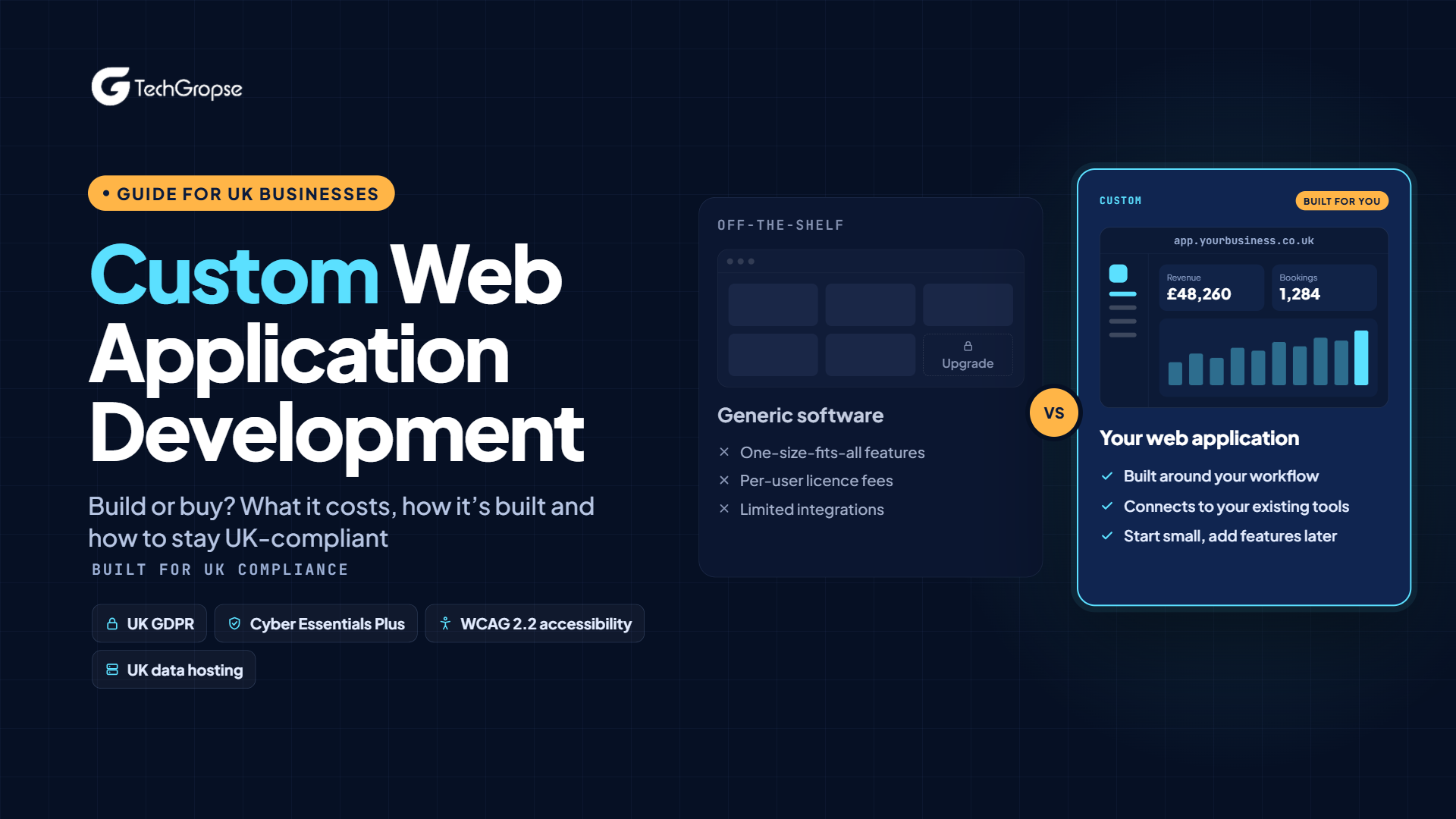
For UK businesses, choosing between a custom web application and an off-the-shelf product comes down to more than the initial price. An existing platform may handle everyday tasks well, but what happens when the business needs integrations, approval workflows, or features the product does not support? Custom web application development offers greater control over these requirements, although it also brings development and maintenance responsibilities.
The right choice depends on how well each option fits your current processes, budget, and plans for growth. This guide compares the costs, technologies, development process, and security considerations UK businesses should assess before investing.
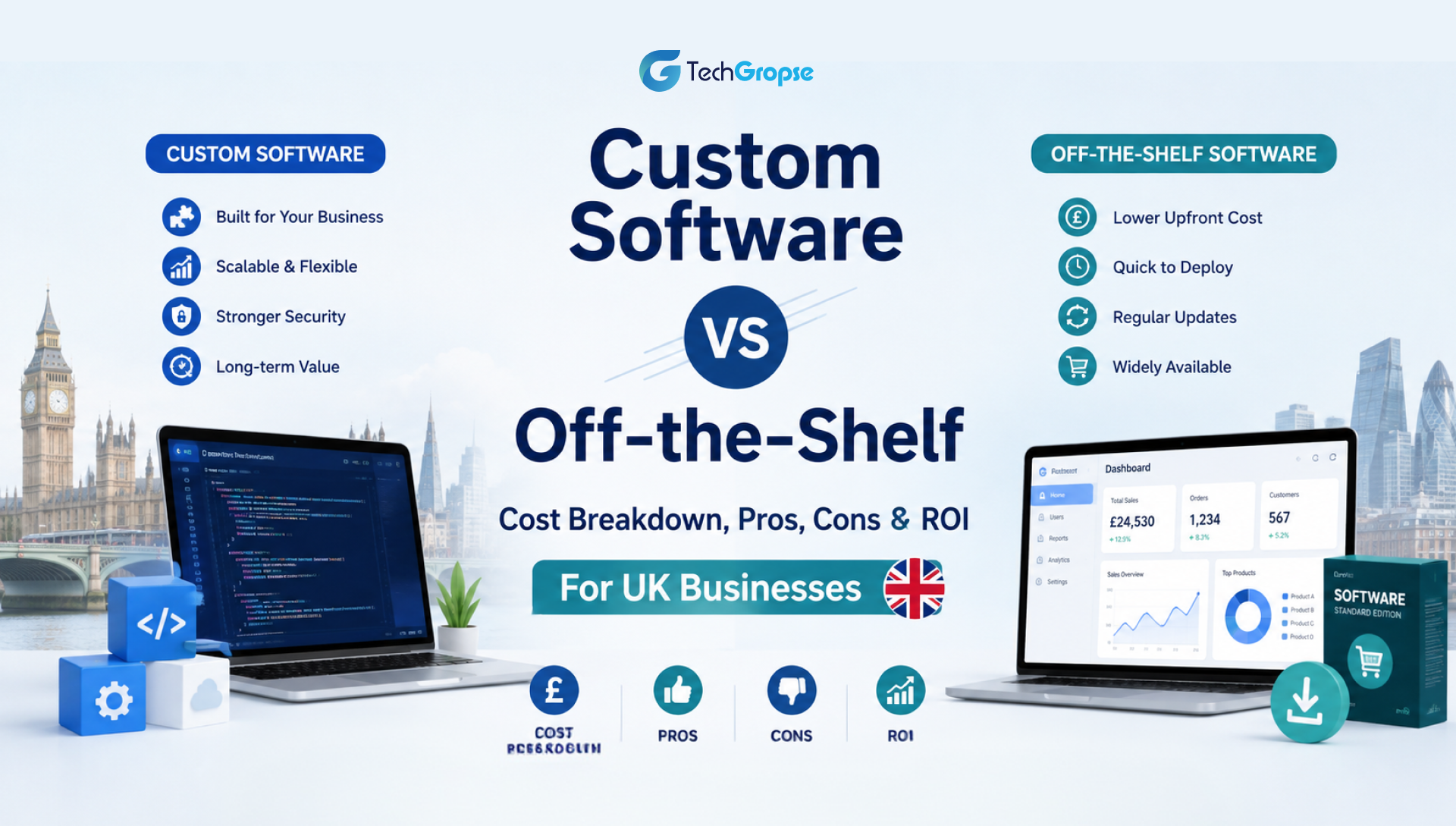
Off-the-shelf software covers everyday business needs, but it becomes restrictive when processes grow more complex. Custom web app development services, on the other hand, can be built around specific workflows, existing systems, and customer requirements. The trade-off comes down to upfront investment, maintenance costs, and the freedom to make changes later.
Understanding these differences helps businesses choose software that fits how they actually operate. This guide explains how custom web application development services help UK businesses and how to choose the best one.
Here’s what UK businesses should consider before deciding.
Strategic Ownership vs Renting of a Custom Web Application
With off-the-shelf software, UK businesses pay a subscription to use a product developed and managed by another company. A custom application works differently; the business owns and manages it directly. With a web application development service, a UK business of any size gets a customized solution that grows their operations.
| Comparison Factor | Strategic Ownership | Renting (Subscription-Based Software) |
|---|---|---|
| Control | Features and workflows tailored to business needs. | Features and workflows depend on the provider's offerings. |
| Initial Cost | Requires a higher upfront investment in development. | Usually involves lower initial costs with recurring subscription fees. |
| Customisation | Supports business-specific features and integrations. | Customisation is limited to the provider's available options. |
| Maintenance | The business must budget for ongoing maintenance and updates. | The provider manages core software maintenance and updates. |
| Scalability | Evolve as business requirements and operations change. | Scaling depend on subscription tiers and provider capabilities. |
| Data and Integrations | Offers greater control over data architecture and system integrations, subject to hosting and licensing arrangements. | Data access and integrations depend on the provider's policies and technical capabilities. |
| Long-Term Costs | Higher initial costs, with ongoing expenses for improvements. | Recurring fees accumulate as users, features, and usage increase. |
| Best Suited For | Businesses with specialised workflows and long-term technology plans. | Businesses that need standard features with minimal technical management. |
Choosing to own custom web applications is separate; understanding the investment required . The cost dependis another directly on complexity, integrations and security requirements.
How Much Does Custom Web Application Development Cost in 2026?
The cost of custom web application development in 2026 depends on what the application needs to handle, not just the number of pages it contains. A customer portal with login, account management, and document downloads requires less development effort than a platform connecting payment gateways, inventory systems, customer records, and automated workflows. The same applies to security requirements, reporting dashboards, user roles, and third-party integrations; each adds to the time and expertise needed to build and test the application.
For UK businesses, the initial development budget should also account for expenses beyond coding, including UI/UX design, quality assurance, cloud hosting, ongoing maintenance, and future feature updates. For example, a business replacing disconnected spreadsheets and subscription tools with one custom application needs to consider how existing data will be migrated and how the new system will connect with its current software.
| Web App Type | Cost in GBP | Estimated Timeline |
|---|---|---|
| Simple Web Application | 8,000 to 30,000 | 2 to 3 Months |
| Advanced Web Application | 30,000 to 80,000 | 3 to 6 Months |
| Enterprise-grade Web Application | 80,000 to 1,50,000 | 6 to 12 Months |
Budget is only a part of building a custom web application software. The technologies behind it also affect how quickly the application responds, how securely it handles business data, and how easily new features can be added.
Technologies That Power Web Application Development Service in 2026
The technology stack should reflect what the application needs to do, rather than simply follow current development trends. A customer-facing portal prioritise fast page loads and a smooth user experience, while an internal operations platform need reliable database transactions, role-based access, and connections to existing business systems.
For example, React or Vue are useful to make interactive interfaces, while Node.js or Python handle back-end operations and integrations. PostgreSQL is suitable for structured business data, and cloud platforms such as AWS or Microsoft Azure provide hosting options. The final choices depend on the application’s workload, existing systems, security requirements, and the team’s ability to maintain it.
-
Front-End Engineering
TypeScript with Next.js and React are useful to build interactive dashboards, customer portals, and complex multi-step workflows. Vue and Nuxt are also suitable for applications requiring a component-based interface. Tailwind CSS and Shadcn UI help teams build consistent layouts, forms, and reusable interface components.
-
Back-End and Microservices
Node.js with NestJS manage APIs, order events, notifications, and real-time updates. Python frameworks such as FastAPI suit AI integrations, document processing, and data-heavy services. Go is another option for high-concurrency workloads where efficient resource usage matters.
-
Database and Data Persistence
PostgreSQL store customer records, transactions, inventory, and operational data in a structured format. The pgvector extension adds vector similarity search for applications using semantic search or retrieval-augmented generation. Redis enables caching, while Prisma and Supabase simplify database access and application development.
-
Cloud Infrastructure and Deployment
AWS London and Microsoft Azure UK South are options for businesses evaluating UK-based cloud deployments. Cloudflare Workers run selected tasks closer to users, while Docker and Kubernetes support containerised deployment and orchestration. The final setup should reflect data residency obligations, availability targets, traffic patterns, and operational budgets.
-
API Development and Third-Party Integrations
REST and GraphQL APIs connect web applications with payment gateways, CRM platforms, ERP systems, and external data sources. Tools such as Postman support API testing, while OAuth 2.0 and OpenID Connect help manage authentication and authorised access. These technologies are particularly useful for UK businesses connecting existing software without replacing their entire technology stack.
-
Security and Identity Management
Enterprise applications handling customer records, financial transactions, or employee information require security controls at multiple levels. OAuth 2.0, OpenID Connect, multi-factor authentication, and role-based access control help protect user accounts and restrict sensitive operations. Encryption, audit logging, dependency scanning, and secure development practices further support GDPR compliance and internal security requirements.
-
Testing, Monitoring, and Performance Optimisation
Automated testing helps identify defects before they affect customers or business operations. Playwright and Cypress support browser-based end-to-end testing, while Jest and Vitest are commonly used for unit and component tests. Tools such as Sentry and OpenTelemetry help teams investigate application errors, trace requests, and identify performance bottlenecks after deployment.
-
CI/CD and Development Automation
Continuous integration and continuous delivery pipelines automate testing, build processes, and application deployments. GitHub Actions and GitLab CI/CD run automated checks whenever developers update application code. Combined with Docker-based environments and infrastructure-as-code tools such as Terraform, these pipelines help development teams deliver updates consistently across staging and production environments.
Choosing the right technologies is only one part of the project. The team must also validate requirements, test integrations, and confirm that the application works under realistic conditions. A defined development process helps businesses review progress at each stage and address problems before they become expensive to fix.
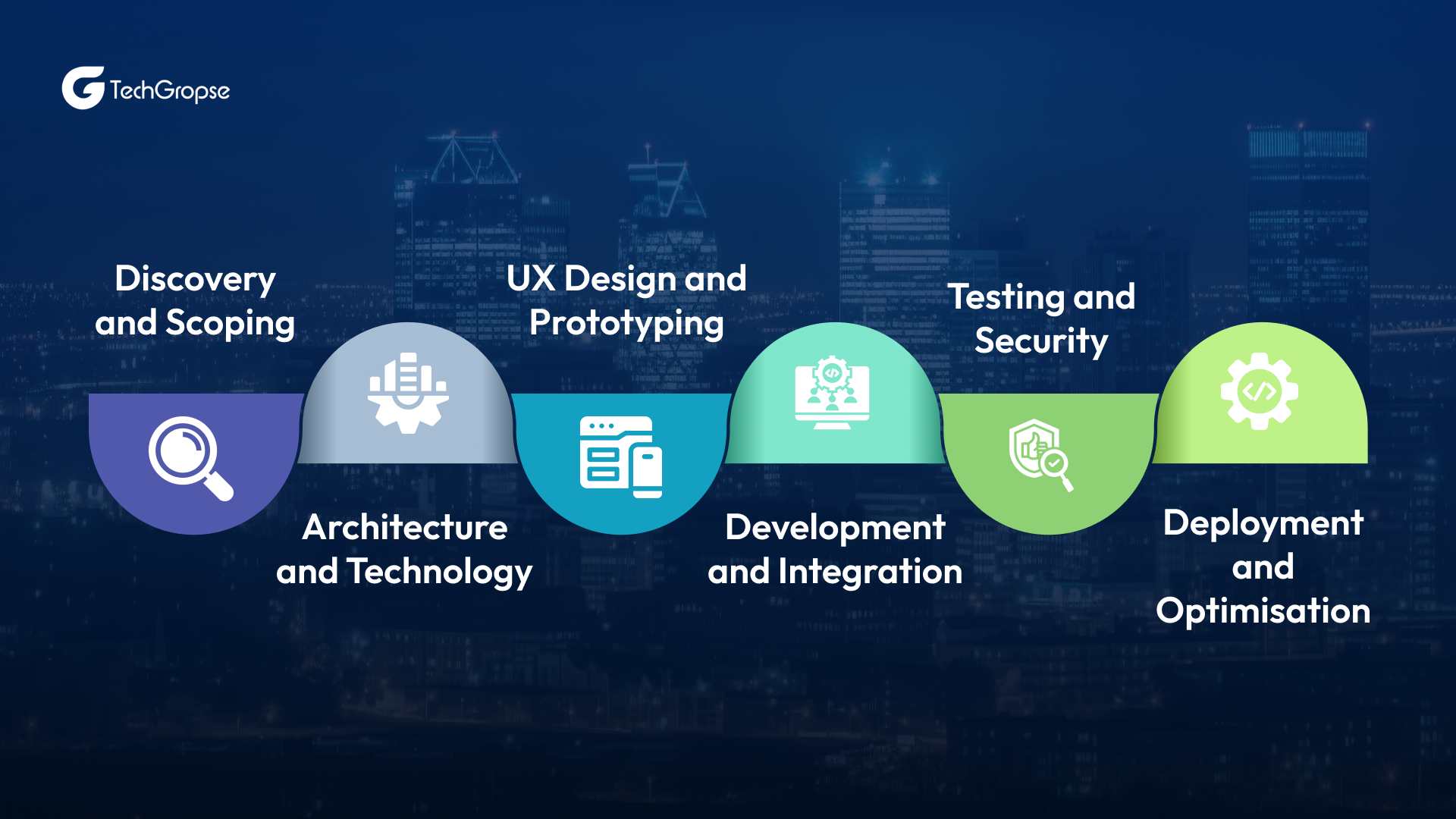
The Six Stages of Enterprise Web Application Development
Building an enterprise web application involves more than writing code and launching a product. Each stage addresses a different challenge, from defining business requirements to preparing the application for real users. A structured six-stage process helps UK businesses track progress, identify risks early, and ensure the finished application helps in their day-to-day operations.
-
Business Discovery and Scope Definition
Before development begins, the team needs to understand where existing processes fall short. For a UK distributor, that might mean replacing manual stock updates, disconnected sales records, and spreadsheet-based order tracking. These findings establish the required features, project boundaries, priorities, and acceptance criteria.
-
Architecture and Technology Selection
Technical decisions made here affect how easily the application accommodate new users, integrations, and business rules. Developers map data flows, choose the database, define API connections, and select suitable hosting infrastructure. If the application handles customer payments or sensitive records, security and access controls must also influence the architecture.
-
UX Design and Interactive Prototyping
A warehouse manager, finance executive, and customer use the same application for very different tasks. Designers map those journeys, create wireframes, and build interactive prototypes before the full interface is developed. Early feedback helps resolve confusing navigation, unnecessary steps, and missing information without expensive rework later.
-
Application Development and Integration
Developers turn approved designs into working software, building the interface, business logic, database operations, and APIs. They also connect external services such as payment gateways, CRM platforms, or accounting systems. Features are delivered in manageable increments, allowing stakeholders to review working functionality instead of waiting until the entire application is complete.
-
Quality Assurance and Security Validation
Testing needs to reflect actual business conditions, not just whether individual buttons work. Teams verify user permissions, integration failures, transaction accuracy, browser compatibility, performance under load, and recovery from errors. Security checks and user acceptance testing help identify problems before employees or customers depend on the application in production.
-
Deployment, Monitoring, and Continuous Improvement
Launching the application involves configuring the production environment, migrating approved data, setting up monitoring, and preparing users for the change. After release, the team tracks errors, response times, and user feedback to identify areas for improvement. Regular updates, security patches, and planned enhancements keep the application aligned with changing business requirements.
UK Regulatory Compliance, Data Sovereignty & Cybersecurity in 2026
The application must also protect business data and meet the regulatory requirements relevant to its operations. Custom web application development services help UK businesses address security, data storage, and access controls during development rather than treating them as last-minute requirements.
-
UK GDPR and Data Protection Act 2018
A customer portal handling personal information needs clear rules for collecting, storing, accessing, and deleting that data. UK GDPR Article 25 requires data protection by design and default, making privacy controls part of the development process. Consent mechanisms should be used where consent is the appropriate legal basis, alongside processes for handling data access and erasure requests.
-
Data Residency and Sovereignty
Where an application stores data influence procurement decisions, particularly for organisations working with public bodies or regulated industries. AWS London and Azure UK South offer UK-based hosting options, but selecting a UK region alone does not guarantee compliance. Businesses must also assess backups, support access, subprocessors, contractual terms, and any sector-specific data handling obligations.
-
Cyber Essentials and Cyber Essentials Plus
For businesses bidding on government contracts or handling sensitive commercial information, cybersecurity affect whether a supplier meets procurement requirements. Cyber Essentials provides a baseline framework covering areas such as firewalls, secure configuration, user access, malware protection, and security updates. Cyber Essentials Plus adds independent technical verification, helping businesses demonstrate that relevant security controls work in practice.
-
Accessibility Under UK Law
An application that customers cannot navigate with a keyboard or understand through a screen reader create barriers to completing essential tasks. Public sector websites and apps must meet applicable accessibility regulations, while private businesses should consider their obligations under the Equality Act 2010. Accessible forms, clear error messages, sufficient contrast, and properly labelled controls help make applications usable by more people.
How to Select and Vet a UK Web Application Development Partner?
A proposalmay look competitive, but the real differences emerge when you examine how a team handles security reviews, third-party integrations, changing requirements, and post-launch support. Before committing your budget, assess potential partners on their technical experience, delivery process, and ability to work within your business and regulatory requirements.
- Ask for applications the team has built with similar business logic, user roles, and integrations. If you need a supplier portal connected to an ERP, check whether the team has handled synchronisation, duplicate records, and failed data transfers.
- Ask why they recommend a particular framework, database, or cloud platform. A capable team should explain the trade-offs in terms of performance, maintenance, security, and development costs rather than simply listing popular technologies.
- Check whether the quote covers discovery, interface design, development, integrations, testing, deployment, and documentation. Ask how additional features are priced and what happens when a third-party system requires more integration work than expected.
- Find out how developers manage source-code access, test for vulnerabilities, protect production data, and apply security updates. If the application handles personal information, ask how the proposed design helps your obligations under UK GDPR.
- Confirm the roles of the project manager, designers, developers, and QA engineers. Ask whether the people presenting the proposal will remain involved during delivery and whether any work will be outsourced.
- Confirm access to source code, repositories, design files, technical documentation, and deployment credentials. Review intellectual property terms and third-party licences before signing the agreement, not after the application is complete.
- Ask how the team will test the application before launch, manage production issues, and deliver future updates. Check whether maintenance is included in the quote or charged separately, and request clear response times for critical faults.
Why Choose TechGropse for Custom Web Application Development?
TechGropse develops custom software and web applications for businesses that need more than a standard website or an off-the-shelf product. Its work include business dashboards, customer portals, workflow automation, API integrations, and AI-powered features. For UK companies planning to consolidate disconnected systems or digitise manual processes, the starting point should be a clear assessment of existing workflows, required integrations, and the functionality the application must deliver.
Before selecting TechGropse, discuss the project scope, proposed architecture, delivery milestones, source-code ownership, and post-launch support directly with the team. Ask how the proposed application will connect with your existing systems and how future changes will be handled. A detailed proposal built around these requirements gives your business a clearer basis for evaluating cost, technical suitability, and long-term maintainability before committing to development.
Frequently Asked Questions
Custom web application development services cover the full build: discovery and scoping, UX design and prototyping, architecture, front-end and back-end development, third-party integrations, testing, security checks, deployment and post-launch support. Scope varies by supplier, so check the proposal for what is included, especially documentation, data migration and maintenance.
Expect ongoing costs for cloud hosting, security updates, monitoring, support and third-party services such as payment or messaging APIs, plus any new features. A common rule of thumb is to budget around 15% to 20% of the build cost per year for maintenance. Ask your supplier for an itemised estimate, as this varies by project.
Not automatically you, even if you pay for it. Under UK copyright law, an assignment of copyright must be in writing and signed. Agree ownership of source code, designs, documentation and deployment credentials in the contract before development starts, and check how third-party and open-source components are licensed.
Yes. Custom applications connect to existing systems through REST or GraphQL APIs, including CRM and ERP platforms, accounting software, payment gateways and other data sources. The effort depends on the quality of the other system’s API, so ask your supplier to assess each integration during discovery rather than after you’ve agreed a price.
Yes, and it is a safer approach. Build a minimum viable product around the single process that causes the most friction, test it with real users, and add features based on actual usage. This limits upfront spend and avoids building features nobody needs. Plan the architecture early so later additions don’t force a rebuild.

Saurabh Singh is a Senior Enterprise Content Writer at TechGropse, specializing in translating complex technologies into clear, insightful, and business-focused content. His expertise spans enterprise technology, software development, AI-driven solutions, and digital transformation, with a focus on connecting technical capabilities to real-world business objectives. He has contributed to content initiatives for TechGropse clients such as Home101, Artera, Peekabox, and Zayed University, bringing their products, services, and technological offerings to life through strategic storytelling. His work involves simplifying complex concepts, communicating software value propositions, and translating emerging technology trends into meaningful narratives for business leaders, decision-makers, and end users. Through a blend of technical understanding and business-oriented communication, he makes complex solutions accessible, relevant, and valuable to diverse audiences.