 +447413083355

































Picture this. You run a fintech company in London or Manchester. Funding has gone quiet this year. Investors are cautious. Yet every competitor pitch deck you see now leads with “AI-powered.” You know you need to move, but nobody’s told you where to start, what AI app development in UK actually costs, or which agency understands both AI and the FCA’s rulebook. This guide fills that gap.
Here’s the twist nobody saw coming. UK fintech investment fell 67% year-on-year to just £1.8 billion in the first half of 2026, the lowest six-month total in a decade, according to KPMG’s Pulse of Fintech report. But AI-related fintech firms bucked the trend entirely. They raised £445 million across 79 deals, and their share of total UK fintech investment jumped to 25%, up from 16% the year before. Money is leaving fintech generally and piling into fintech that actually uses AI. That’s not a small shift. That’s the whole market repricing what “fintech” means.
This guide breaks down exactly how AI app development in UK is reshaping fintech, what UK regulators expect, what fintech app development in the UK actually costs in 2026, and how to choose the right development partner. Plain English throughout. No jargon for the sake of it.
What Do We Actually Mean by AI in Fintech?
Let’s clear this up first, because “AI in fintech” gets used loosely.
AI in fintech means using machine learning, natural language processing, and predictive models to do things a human used to do manually. Or things a human couldn’t do fast enough at all.
That covers a wide range:
- Spotting fraud in milliseconds, not hours
- Approving or declining a loan application in seconds
- Answering a customer query at 2 am without a human agent
- Flagging a compliance breach before it becomes a fine
- Personalising a savings recommendation based on real spending habits
AI fintech isn’t one product. It’s a layer that sits across nearly everything a financial app does now. And UK fintech firms have been quicker to adopt it than most other sectors, which brings us to where things actually stand.
Fintech UK in 2026: The State of Play
Let’s look at the numbers, because they tell a clear story.
Adoption is properly high: According to the 2026 Global AI in Financial Services Report from Cambridge Judge Business School’s Cambridge Centre for Alternative Finance, UK fintechs lead traditional financial firms by 47% to 30% in advanced AI adoption. They’re also nearly three times more likely to be at a fully transforming stage of AI use: 19% versus 6% for incumbents.
Regulators are Catching Up: The same report found that among 130 regulatory authorities surveyed worldwide, 48% are still at the exploring stage with AI, or not engaged with it at all. Fintech is ahead of the people meant to be watching it.
The Bank of England and FCA Have Been Tracking this Closely: Their most recent joint survey of UK financial services firms found 75% already using AI, up from 58% two years earlier, with a further 10% planning adoption within three years. Insurance firms lead at 95% adoption. Financial market infrastructure firms trail at 57%.
Fintech UK is still Europe’s Biggest Hub: The UK holds 65% of its 3,300+ fintech firms actively using AI for core operations, not just pilot projects, according to industry data cited by Bill Gosling’s UK fintech analysis. The UK fintech market itself is projected to grow at a CAGR of 15.67%, reaching an estimated $38.45 billion by 2030.
And AI investment keeps rising even as broader fintech investment falls. AI-driven fintech investment globally hit £16.8 billion in 2025, up from £12.1 billion the year before, per KPMG’s Pulse of Fintech data.
The picture is simple. UK fintech firms are adopting AI faster than regulators and faster than their own incumbent competitors. That’s the backdrop for everything below.
Where AI Is Actually Changing UK FinTech Right Now
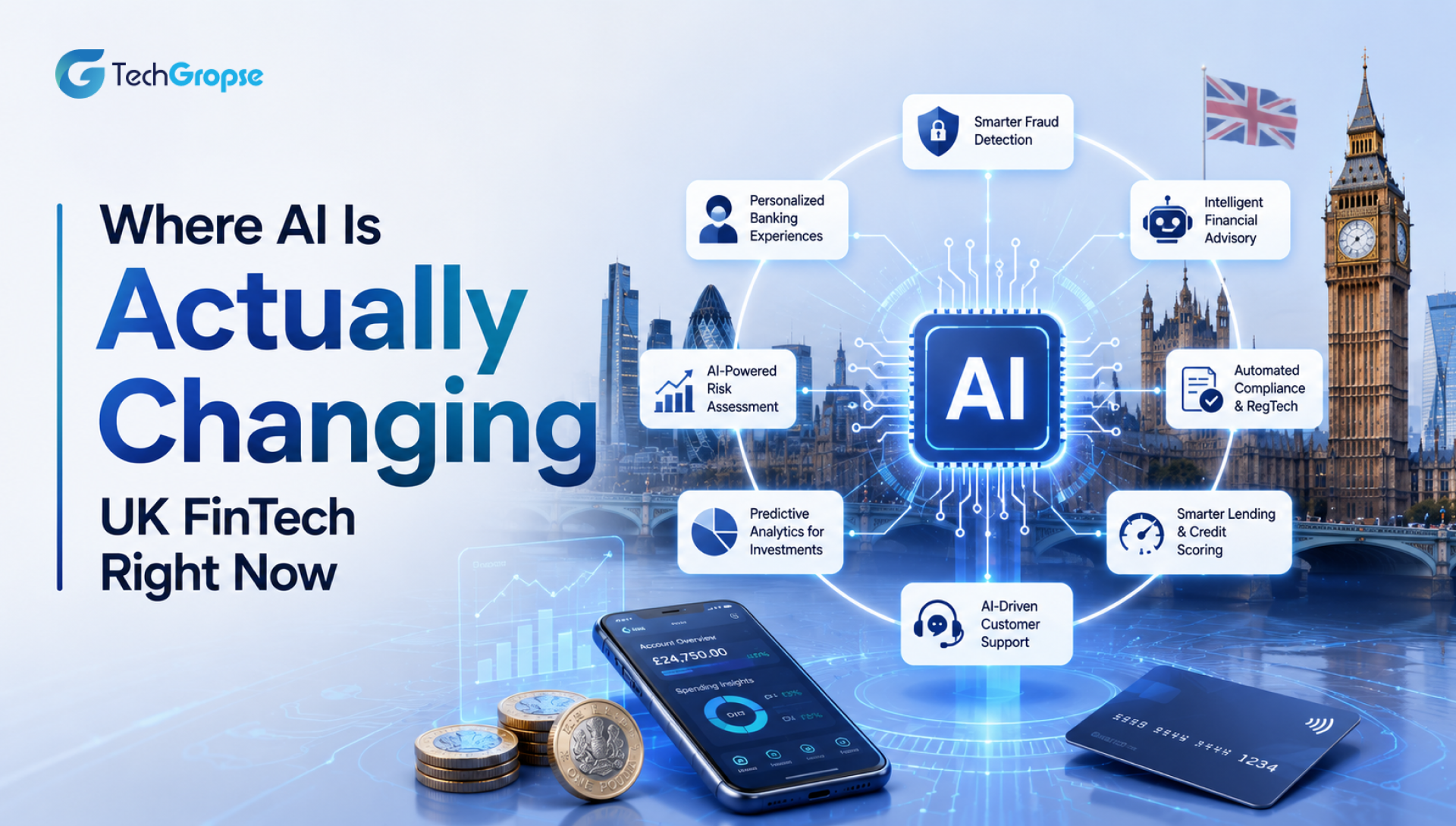
We have already discussed the use of fintech and AI app development in UK. Let’s take a look at the places AI is already doing real work inside UK financial firms.
Fraud Detection That Works in Real Time
Old-school fraud checks flagged suspicious activity after the fact. AI checks it as it happens. Machine learning models learn what normal looks like for each customer. A sudden large transaction, an odd location, a strange spending pattern- all get flagged in seconds.
That matters more than ever: UK government figures estimate 612,000 businesses and 61,000 charities faced cybersecurity breaches in a single year.
Credit Scoring and Lending Decisions
Traditional credit scoring relies on a narrow set of static data. AI-driven underwriting looks at a much wider picture: spending behavior, income patterns, digital footprint.
The result is faster approvals and, done properly, fairer lending. Customers who’d have been rejected by a traditional bank’s rigid criteria can get a fair look based on their actual financial behaviour.
Personalisation That Doesn’t Feel Generic
Robo-advisers now build investment plans around a person’s actual goals and risk appetite, not a one-size-fits-all model portfolio.
NLP-powered chatbots handle everything from balance queries to detailed financial guidance, 24 hours a day. No hold music. No “your call is important to us.”
RegTech and Compliance That Doesn’t Slow You Down
This is a properly underrated use of AI app development in UK fintech. RegTech is growing at roughly 22% a year in the UK, with more than 100 dedicated RegTech startups now operating.
AI handles:
- Automated auditing that cuts down human error
- Real-time monitoring that flags compliance risks as they happen, not at quarterly review
- Smart reporting that turns a two-week compliance task into a same-day one
Back-office Automation Nobody Sees
This is an unglamorous end of AI fintech, and it’s where a lot of the actual cost savings happen.
Robotic process automation and NLP now handle KYC document checks, onboarding workflows, and data reconciliation that used to eat up entire teams’ time. It’s not exciting. It’s a real driver of better operating margins.
Open Banking and Embedded Finance
The UK’s Open Banking infrastructure, one of the most mature in the world, now serves over 16.5 million users. AI sits on top of that infrastructure to power smarter budgeting apps, automated savings tools, and embedded finance products that live inside non-financial apps entirely.
This is where a lot of AI app development in UK fintech work is actually happening in 2026: not building banks from scratch, but building smart, AI-powered layers on top of Open Banking rails that already exist.
Which Areas of UK FinTech Benefit Most From AI?
Not every corner of UK fintech is moving at the same speed. Some sectors are further ahead than others, and that matters if you’re scoping AI app development in UK for your own business.
Digital Banking and Neobanks
This is where AI in fintech shows up most visibly to end users: spending insights, saving nudges, and fraud alerts baked straight into the everyday banking app. UK digital banks were early adopters and remain the benchmark for what “good” looks like.
Payments
Real-time fraud scoring sits at the centre of every payments business now. With authorised push payments scams and account takeovers on the rise, AI-driven anomaly detection isn’t optional anymore; it’s the baseline expectation from both regulators and customers.
Lending and Consumer Credit
AI-driven underwriting is quietly reshaping who gets approved for credit in the UK. Firms using broader behavioural data, rather than a narrow credit score, are approving more creditworthy customers that traditional models would have missed.
Wealthtech and Robo-Advice
Personalisation is the entire product here. An AI-driven wealth platform that doesn’t tailor its advice to a customer’s actual goals and risk tolerance isn’t competing on equal terms in 2026.
Insurtech
AI-powered claims processing and risk pricing are cutting settlement times from weeks to days in some UK insurtech firms, while improving fraud detection on claims at the same time.
RegTech
As covered above, this is one of the fastest-growing categories in UK fintech, and one of the clearest cases where AI app development in UK pays for itself quickly through reduced compliance headcount and faster reporting.
If your business sits in one of these categories, the AI features worth prioritising in your next build are usually obvious once you look at what your specific sector’s leaders are already shipping.
Startup, Scale-Up, or Enterprise: How the AI App Development in UK Fintech Approach Changes
The right approach to AI app development in UK fintech looks different depending on where your business actually sits.
- Pre-seed and Seed-Stage startups should resist the urge to build everything at once. One well-executed AI feature, fraud detection or a properly useful chatbot, beats five half-built ones. Investors want proof the AI works, not a long feature list.
- Scale-ups are usually past the “does this work” question and into the “does this hold up at volume” one. This is where data infrastructure investment pays off, since a model that performed well with a few thousand users can behave unpredictably at ten times that scale.
- Enterprise and regulated banks carry the heaviest compliance load, and rightly so. Here, the AI app development in UK conversation is less about speed to market and more about explainability, audit trails, and model governance that satisfies both internal risk teams and the FCA.
Knowing which category your business falls into before you brief an AI app development partner saves time and money later.
What UK Regulation Actually Means for AI in Fintech
Here’s something most content on this topic gets wrong, or skips entirely: what UK regulators are actually doing about AI, right now, in 2026.
The FCA has been direct about this. In a June 2026 blog from the regulator itself, Alex Smith, the FCA’s Head of Cross-cutting Policy & Strategy, confirmed the FCA isn’t introducing new AI-specific regulation.
Instead, it’s relying on existing frameworks: the Consumer Duty, the Senior Managers and Certification Regime, and standard governance expectations.
What the FCA is doing instead is building direct engagement channels through its AI Lab, which includes:
The Supercharged Sandbox, giving firms access to high-performance computing and enriched datasets to test early-stage AI ideas.
AI Live Testing, letting firms trial AI systems in real-world conditions with regulatory oversight, with a second cohort already underway.
AI Spotlight, showcasing how firms are actually experimenting with AI in practice.
There’s also the independent Mills Review, looking into the long-term impact of AI on retail financial services, due to publish findings this summer. This is a live piece of UK policy that any fintech founder building an AI product in 2026 should be watching closely.
The practical takeaway for anyone doing fintech app development in UK: you’re not waiting for a rulebook that doesn’t exist yet. You’re building against the Consumer Duty, SM&CR, UK GDPR, and existing FCA governance rules, all of which already apply to how your AI makes decisions, explains itself, and treats customers fairly.
How Much Does AI Fintech App Development Cost in UK?
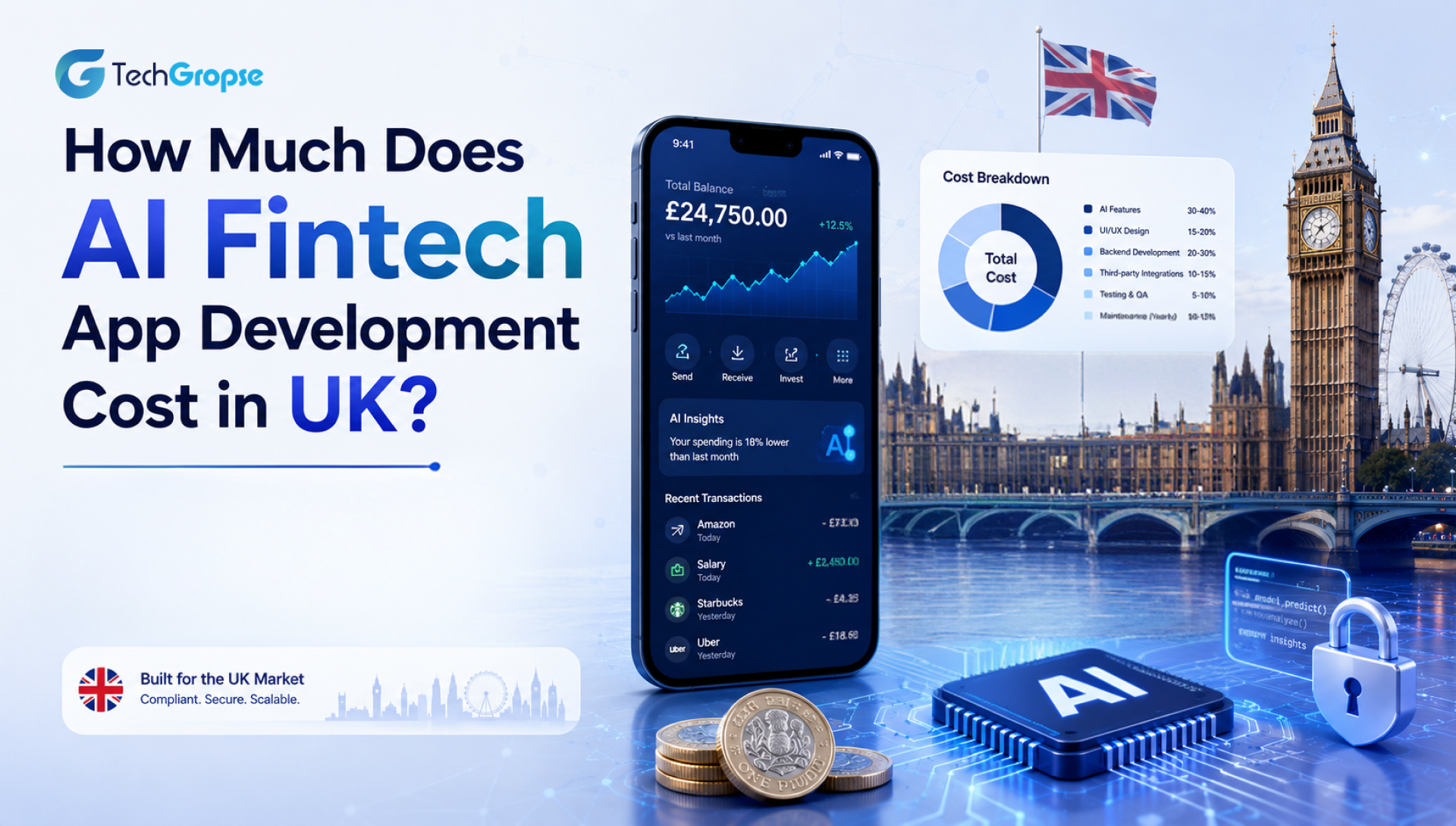
Fair question, and one most content on this topic dodges. Here’s a realistic breakdown based on current UK market rates.
MVP or Proof-of-Concept – £20,000 to £80,000
A focused build, one or two AI features (a chatbot, a basic fraud check), enough to validate the idea with real users.
Mid-market Fintech App – £80,000 to £250,000
A properly built product with AI-driven personalisation or credit scoring. Open Banking integration and the compliance groundwork FCA-regulated firms need.
Enterprise-grade Platform – £250,000 to £500,000+
Full regulatory compliance (FCA, UK GDPR, PSD2, AML/KYC), custom-trained models, and infrastructure built to scale across a larger user base.
A few things that quietly push costs up:
- Compliance and security work typically adds 20 to 30% to the total build, sometimes running £40,000 to £80,000 on its own for a regulated product.
- Biometric authentication and advanced fraud detection can add another £15,000 to £25,000 depending on the SDKs involved.
- Adding genuine AI capability, not just a chatbot wrapper, but real fraud detection or credit intelligence, typically adds 20 to 40% on top of a standard build.
One honest note: three agencies will quote you three very different numbers for the same brief. The variance usually comes down to how seriously each one takes compliance, not how good their code is.
Choosing a Partner for AI App Development in UK: What To Look For
Not every development shop that says “we do AI” actually understands fintech. Here’s what separates a genuine AI app development in UK partner from a generalist agency offering fintech app development services as an afterthought:
- Regulatory Fluency: They should talk about FCA requirements, UK GDPR, PSD2, and AML/KYC without you having to explain what those are.
- Real AI Experience: Ask specifically what data pipeline and model retraining process they’d build, not just which third-party API they’d plug in.
- Open Banking Expertise: With 16.5 million UK users already on Open Banking rails, a partner who’s built on top of that infrastructure before will move faster than one starting from scratch.
- A Track Record with UK-Regulated Clients: Ask for examples, not just a portfolio of consumer apps.
- Honest Cost and Timeline Conversations: If a quote seems suspiciously low for a regulated fintech build, ask what’s been left out.
Common Mistakes UK Fintech Businesses Make With AI
While artificial intelligence offers substantial advantages in transaction automation, predictive underwriting, and customer engagement, deploying machine learning in financial workflows carries severe operational and legal risks when executed improperly. This explores the critical pitfalls that fintech companies encounter during the implementation of AI app development in UK.
- Treating AI as a Chatbot and Stopping There: A support bot is a nice feature. It’s not a strategy. The bigger wins sit in fraud detection, underwriting, and compliance.
- Skipping the FCA Conversation Until Launch: Given how much of UK financial regulation already applies to AI-driven decisions, building compliance in from day one is far cheaper than retrofitting it.
- Underestimating Data Quality: AI models are only as good as the data feeding them. Fragmented, messy customer data undermines even the best model.
- Choosing the Cheapest Quote: Always check the regulatory experience. A low headline price on a fintech build usually means compliance work got left out, and that catches up with you fast.
- Building For Launch Day: An AI model that works well with 500 users can behave very differently with 50,000. Plan for that from the start.
How TechGropse Can Help Fintech Businesses With AI App Development in UK
Most UK fintech founders don’t need convincing that AI matters. What they need is a partner for AI app development in UK fintech who understands both the AI and the FCA rulebook it has to operate within.
TechGropse works with UK fintech businesses on:
- Fintech app development in the UK, built AI-first: Fraud detection, AI-driven credit scoring, and personalised financial guidance designed into the app from the start, not bolted on after launch.
- Open Banking-native builds: Apps that connect properly to the UK’s Open Banking infrastructure, rather than working around it.
- Compliance-aware architecture: UK GDPR, FCA governance expectations, and AML/KYC requirements factored into the technical build from the first planning conversation.
- Honest cost scoping: A clear breakdown of what an MVP, a mid-market app, or an enterprise-grade platform will actually cost, with nothing hidden until later.
If you’re weighing up fintech app development services for a UK-regulated product and want a partner who takes the compliance side as seriously as the AI side, that’s the conversation TechGropse is set up to have.
The Bottom Line
AI in fintech isn’t a future trend in the UK. It’s already how the leading firms operate, how investors are allocating what capital remains, and how the FCA is shaping its regulatory approach. UK fintechs sitting on the sidelines aren’t just missing an opportunity.
They’re falling behind on fraud protection, compliance efficiency, and the customer experience people now expect as standard. Whether you’re planning your first AI feature or a full AI app development in UK from the ground up, the businesses winning right now are the ones treating AI as core infrastructure.

Frequently Asked Questions
AI in fintech powers fraud detection, credit scoring, personalised recommendations, chatbots, and regulatory compliance monitoring. It replaces slow, manual processes with faster, data-driven decisions.
It's properly high. UK fintechs lead traditional financial firms by 47% to 30% in advanced AI adoption, and 75% of UK financial services firms report using AI in some form, according to Bank of England and FCA survey data.
A focused MVP typically runs £20,000 to £80,000. A mid-market app with real AI features and Open Banking integration runs £80,000 to £250,000. Enterprise-grade, fully compliant platforms run £250,000 to £500,000 or more.
Not currently. The FCA applies frameworks, including the Consumer Duty and Senior Managers and Certification Regime, to AI use rather than introducing new AI-specific rules. It runs an AI Lab, including a regulatory sandbox and live testing programme, to support firms building AI products responsibly.
Treating it as a single feature, usually a chatbot, rather than core infrastructure. The bigger returns sit in fraud detection, underwriting, and compliance automation, not customer-facing gimmicks.
If anything, it's a more disciplined time. Broader fintech investment has fallen, but AI-related fintech investment has grown as a share of the total. Businesses building properly AI-driven products are attracting a growing slice of a smaller pool.

Hello all, Aman Mishra has years of experience in the IT industry. His passion for helping people in all aspects of mobile app development. Therefore, he writes several blogs that help the readers to get the appropriate information about mobile app development trends, technology, and many other aspects. In addition to providing mobile app development services in the UAE, he also provides software development, AI development, maintenance & support services, and UI/UX, and integration service to businesses of all sizes.