 +447413083355































Summing It All Up
Determine the business needs: Identify who will use the app, what kind of business value it will provide, what data will be used, who will have access to it and whether it will produce the desired results.
Select the best AI model and tech stack: Analyze the chosen models like OpenAI, Gemini, Claude, and Llama according to their performance, precision, response rate, scalability, and data processing capabilities.
Place importance on data governance: Make sure that the data comes from trustworthy sources, remove outdated data and develop a permission-based retrieval system in order to avoid unauthorized access to sensitive company data.
Include UK GDPR compliance in the development process: Think about lawful basis, minimization of data use, transparency, storage, security, and DPIA during the design of the application.
Ensure testing and constant monitoring: Assess how well it responds, how accurate the retrieval is and whether the safety standards are met before launching the app.
A generative AI application can produce an impressive response during a demonstration. The engineering questions usually emerge later: Can it retrieve the right company document? Will it respect the permissions assigned to an employee? What happens when a customer uploads information that the application was never designed to process?
These questions become business problems when businesses consider how to build a generative AI app that handles real customer records, employee information, contracts, financial documents or internal knowledge. An assistant that retrieves the wrong customer record can expose confidential information. Similarly, a chatbot that sends personal data to an external model provider without appropriate controls can create a data protection risk.
Connecting an LLM to an interface is relatively straightforward. The harder work begins when the application needs to communicate with business systems, retrieve restricted information and handle personal data without exceeding the purpose for which it was collected.
That makes UK GDPR compliance a development consideration, not a final-stage security check. This guide explains how to build a generative AI app that addresses practical business requirements while incorporating data protection into its architecture and development process.
What Is a Generative AI Application?
A generative AI application uses a model to create or transform content in response to user instructions and available information. It might draft customer emails, summarise contracts, answer questions about company policies, generate product descriptions or help employees search large document collections.
However, the model is only one part of the application.
Consider an internal AI assistant that helps employees answer questions about customer accounts. The employee enters a query, the application checks their identity, retrieves relevant records, sends selected context to an AI model and presents a generated response.
Why UK Businesses Are Investing in Generative AI?
Many businesses have more information than their teams can use efficiently. Customer support departments work across ticketing systems, product documentation and customer histories. Legal teams review lengthy contracts. Sales teams search CRM records, proposals and product information before responding to prospects.
These workflows involve repeated information retrieval and content preparation. Generative AI can help, but only when it fits the actual Generative AI app development process.
Take a customer support team handling hundreds of queries each day. Employees may spend several minutes finding the correct policy, checking a customer’s previous interactions and drafting a response. A generative AI assistant could retrieve approved support documentation, summarise relevant account information and prepare a response for the employee to review.
The business value is not simply faster text generation. It comes from reducing the time spent moving between systems and locating information.
Other practical applications include:
- Contract analysis: Extract clauses, summarise obligations and flag sections that need legal review.
- Internal knowledge assistants: Help employees find answers across approved company documents.
- Customer service automation: Draft responses using relevant support history and approved policies.
- Document processing: Convert unstructured files into summaries, classifications or structured data.
- Sales enablement: Prepare proposal drafts using approved product information and CRM context.
What Businesses Should Consider Before Development
A business may know that it wants an AI chatbot, document assistant or automated content tool. That description is not enough to define a secure application. The development team needs to understand the people, information, and decisions involved.
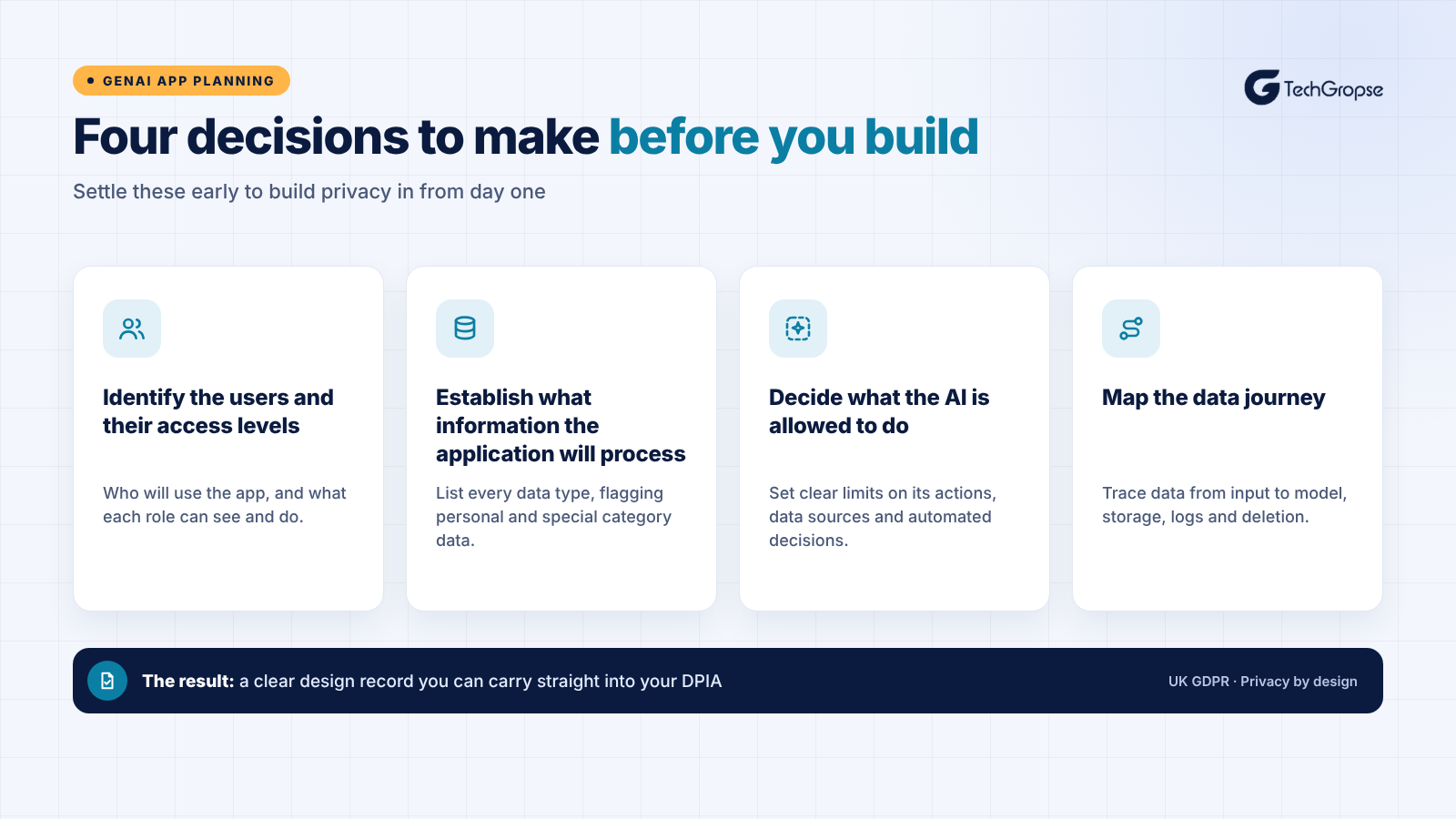
Identify the users and their access levels
An AI assistant for employees has different requirements from a public-facing customer chatbot. An employee knowledge tool may need role-based access to internal documents, while a customer-facing assistant should only retrieve information relevant to the customer’s account and permitted service.
Define user groups, access levels and the actions each group can perform. Do not assume that everyone who can open the application should be able to access every connected data source.
Establish what information the application will process
List the information the application needs, including user prompts, uploaded files, retrieved documents, generated outputs and conversation history. Identify whether these sources contain personal data, confidential business information, or special category data.
This exercise often reveals data that the business does not need to collect. If an AI assistant can answer a question using an anonymised order reference, it may not need the customer’s full address or other identifying details.
Decide what the AI is allowed to do
There is a significant difference between an application that drafts a recommendation and one that makes a decision affecting an individual.
For example, an HR assistant that summarises an employee policy is not performing the same function as a system that automatically ranks candidates or recommends disciplinary action. The latter raises more serious questions about accuracy, fairness, human oversight and automated decision-making.
Define the application’s boundaries before selecting the model or building the workflow.
Map the data journey
Document where information enters the system, how it is processed, which providers receive it, where it is stored and when it is deleted. Include external APIs, analytics services, logging platforms and monitoring tools.
This map helps the business identify where personal information could be exposed or retained unexpectedly. It also gives developers a practical reference when implementing privacy and security controls.
How to Build a Generative AI App: 8 Development Steps
A reliable generative AI application is built through a sequence of connected decisions. The following process covers the main technical and operational stages to build a generative AI application.
Step 1. Define the Business Use Case and Requirements
Start with the task the application must perform, not the AI feature the business wants to demonstrate.
Suppose an insurance company wants to reduce the time employees spend reviewing incoming claims. A useful first version might extract relevant details from submitted documents, summarise the claim and identify missing information for an employee to check.
That is a more manageable requirement than asking AI to process claims from beginning to end.
Document the expected inputs, outputs, users, integrations and success measures. Decide whether the application will provide information, prepare recommendations or take actions. Also identify situations where it must stop and refer the task to a human.
Useful requirements include:
- Business problem and intended outcome.
- Target users and access permissions.
- Data sources and information categories.
- Required integrations with existing systems.
- Expected response quality and performance.
- Human review and escalation requirements.
- Privacy, security, and compliance constraints.
These requirements become the basis for architecture, development and testing.
Step 2. Select an AI Model That Fits the Workload
Choosing a model based only on popularity or benchmark scores can lead to unnecessary cost and integration problems. Different applications have different requirements for reasoning, latency, context length, language support and data handling.
A business building a document summarisation tool may prioritise context capacity and consistent extraction. A customer-facing assistant may need low response times, multilingual support and predictable operating costs. A specialised application may benefit from an open-weight model that can be deployed in a controlled environment.
Common options include:
- OpenAI models: For language generation, reasoning and application workflows.
- Google Gemini: For multimodal tasks and applications that need to work with different content formats.
- Anthropic Claude: For language-intensive tasks such as document analysis and summarisation.
- Llama models: For teams evaluating open-weight model deployment and greater infrastructure control.
The model provider is only one part of the decision. Review its data-processing terms, retention settings, training policies, available security controls, processing locations and contractual commitments. These details matter when personal information is sent through an external API.
Avoid locking the entire application to one provider unnecessarily. A model integration layer can make it easier to evaluate alternatives, although switching models still requires compatibility, quality and security testing.
Step 3. Prepare and Govern the Data
A retrieval-based application can have access to thousands of documents and still produce poor answers. The problem may be outdated policies, duplicate files, missing metadata or documents that were never intended for the same audience.
Data preparation should therefore involve more than uploading files into a vector database.
A typical process includes:
- Identify approved data sources and assign ownership.
- Remove duplicate, obsolete or irrelevant documents.
- Check document quality and resolve extraction errors.
- Classify information according to sensitivity and access requirements.
- Add metadata such as document type, department, version and access group.
- Define retention and deletion rules.
- Establish a process for updating or removing information.
For a retrieval-augmented generation (RAG) application, documents are commonly divided into smaller sections, converted into embeddings and stored in a vector database or another retrieval system. When a user submits a question, the application searches for relevant sections and passes selected context to the model.
The important design decision is how retrieval respects the original document permissions. A finance employee should not receive restricted HR information simply because it is semantically relevant to a question. Access checks must apply before restricted content is included in the model context.
Step 4. Design the Application Architecture
The architecture determines how the interface, business systems, data sources and AI model communicate. It also determines where security and privacy controls can be enforced.
A typical enterprise generative AI architecture may include:
- Frontend: React, Next.js or Flutter for the user experience.
- Backend: Python with FastAPI, or Node.js, for application logic and API orchestration.
- Model integration: APIs or a controlled model-serving environment.
- Retrieval layer: Embedding generation, document indexing and semantic search.
- Data storage: PostgreSQL, MongoDB or another suitable database.
- Vector search: pgvector, Pinecone, Weaviate or Chroma, depending on scale and requirements.
- Identity and access management: OAuth 2.0, OpenID Connect and role-based access controls.
- Monitoring: Application logs, model evaluation and operational monitoring.
For example, a business with an existing PostgreSQL environment may be able to use pgvector for an initial RAG implementation rather than introducing a separate vector database immediately. The choice should follow data volume, query patterns, operational capability and scaling requirements.
The architecture should also separate responsibilities. Authentication should not depend on the model’s interpretation of a prompt. The backend should enforce permissions, validate requests and control which tools or data sources the model can access.
Step 5. Develop the Application and Integrate APIs
Once the architecture is defined, developers can build the user interface, backend services, model connections and business-system integrations.
This is where a prototype becomes a working business application. A customer support assistant, for example, may need to connect with a CRM, ticketing platform, product database and approved knowledge repository.
The integration layer should manage:
- User authentication and session handling.
- Input validation and file-upload restrictions.
- API authentication and secret management.
- Retrieval and context construction.
- Model requests and response handling.
- Output validation and error management.
- Human approval for sensitive actions.
Do not give a model unrestricted access to business systems. If an assistant can create a refund, update a customer record or send an email, the application should use narrowly defined tools with permission checks and appropriate confirmation steps.
The model can suggest an action; the backend should decide whether that action is authorised.
Step 6. Implement UK GDPR Requirements in the Design
Privacy controls should be built into the application while data flows and system responsibilities are still being defined. Adding a privacy notice after development will not resolve an application that collects unnecessary personal information or sends it to providers without appropriate safeguards.
Start by identifying the organisation’s role. A business deciding why and how personal data is processed will generally act as a controller for that processing. A service provider processing data on the business’s instructions may act as a processor. Some arrangements can involve different roles across the AI lifecycle, so responsibilities should be assessed for each activity.
Step 7. Test the Application Beyond Functional Accuracy
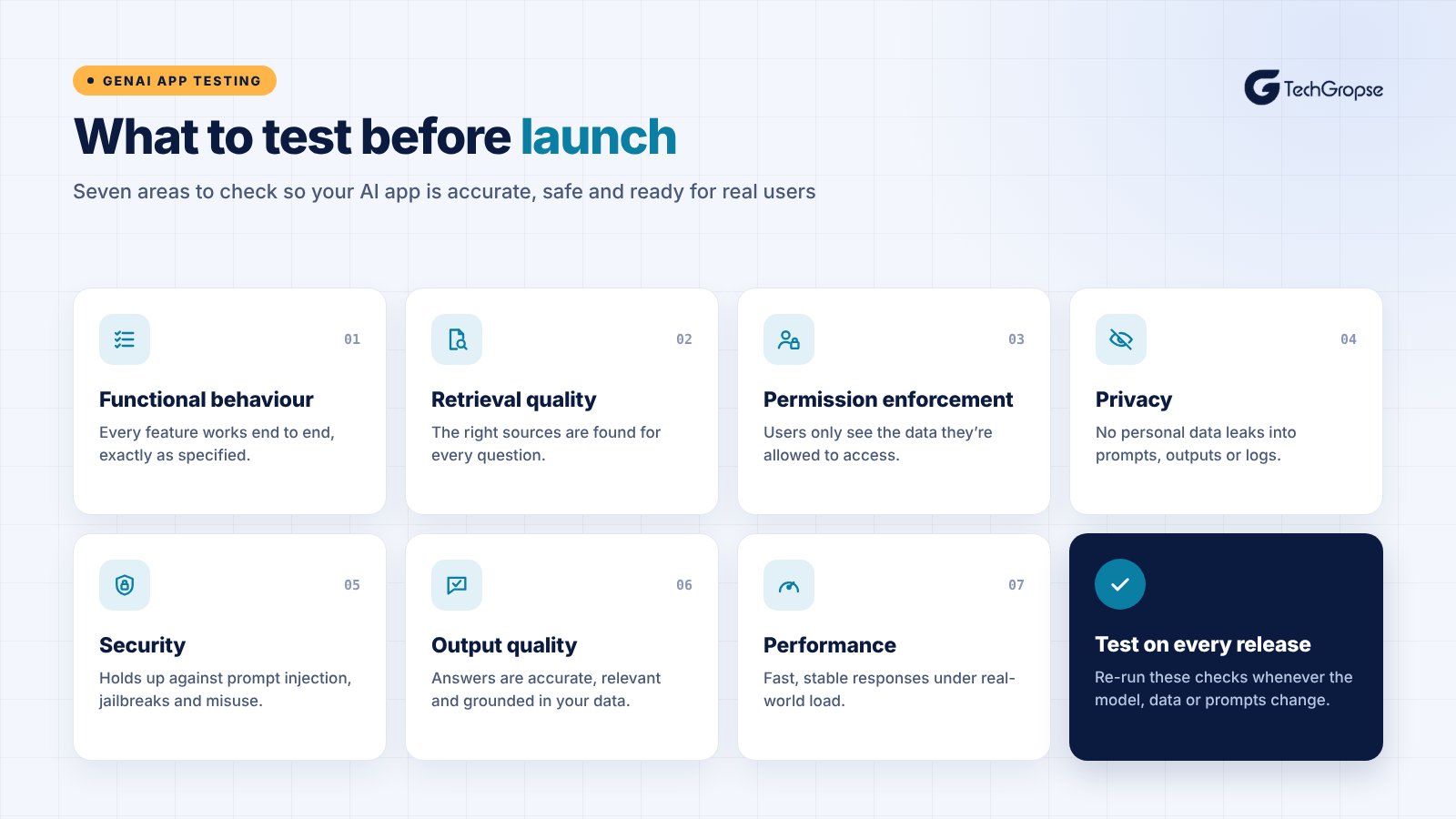
A response that sounds convincing is not necessarily correct, relevant or safe. Testing should examine how the application behaves with realistic data, ambiguous questions, unauthorised requests and unexpected inputs.
For a RAG-based assistant, test whether it retrieves the correct document, identifies outdated information and refuses to reveal content outside the user’s permissions. Check whether generated answers are supported by retrieved sources and whether the application clearly communicates uncertainty.
Testing should cover:
Use synthetic or appropriately protected test data where possible. If real personal data is required for testing, establish the purpose, lawful basis, access controls and retention arrangements for that activity.
Testing should continue after launch. Changes to models, prompts, retrieval settings, documents and connected services can affect application behaviour.
Step 8. Deploy, Monitor and Maintain the Application
Production deployment introduces conditions that a development environment cannot fully reproduce. Request volumes fluctuate, external APIs become unavailable, documents change and users find unexpected ways to interact with the system.
Set up monitoring for response quality, latency, errors, token usage, retrieval performance and unusual access patterns. Track operational costs alongside user adoption so the business can understand whether the application is delivering the expected outcome.
Establish clear ownership for:
- Model and prompt updates.
- Knowledge-base maintenance.
- User access reviews.
- Security incidents and data breaches.
- Retention and deletion requests.
- Provider and contract changes.
- Periodic compliance and performance reviews.
A generative AI application should be treated as a maintained business system, not a one-off software release. Its controls need to evolve as the organisation’s data, workflows and regulatory responsibilities change.
Technology Stack for Generative AI App Development
The technology stack should reflect the application’s workload, data environment, security requirements and expected scale. Selecting tools before understanding these requirements can create unnecessary infrastructure and maintenance costs.
| Application layer | Technology Options | Typical Purpose | ||
|---|---|---|---|---|
| Frontend | React, Next.js, Flutter | Web and Mobile Interfaces | ||
| Backend | Python, FastAPI, Node.js | Business Logic and API Orchestration | ||
| AI Models | OpenAI, Gemini, Claude, Llama | Generation, reasoning, and content processing | ||
| AI Frameworks | LangChain, LlamaIndex, Hugging Face | Model Workflow and Retrieval Integration | ||
| Vector Search | pgvector, Pinecone, Weaviate, Chroma | Semantic retrieval | ||
| Database | PostgreSQL, MongoDB | Application and Business Data | ||
| Cloud Infrastructure | AWS, Microsoft Azure, Google Cloud | Hosting, Storage, and Deployment | ||
| Security | OAuth 2.0, OpenID Connect, IAM, RBAC | Access Control | ||
| Monitoring | LangSmith, Langfuse, cloud monitoring tools | Evaluation and Tracing |
How Much Does Generative AI App Development Cost in the UK?
The cost of generative AI app development in the UK depends on the application’s complexity, data requirements, integrations, security controls and deployment model. A simple chatbot connected to an external model API requires a different level of engineering from an enterprise assistant that retrieves permission-controlled information across several business systems.
The following figures are indicative planning ranges, not verified UK market averages or fixed development quotes.
| Application Type | Estimated Development Cost |
|---|---|
| Basic AI Chatbot | £15,000–£30,000 |
| Generative AI MVP | £20,000–£50,000 |
| RAG-based Knowledge Assistant | £20,000–£60,000 |
| Advanced AI Application | £60,000–£150,000 |
| Enterprise Generative AI Application | £150,000–£300,000+ |
Conclusion
Building a generative AI application is not just a model-integration exercise. Understanding how to build a generative AI app requires businesses to consider how the application retrieves relevant information, respects user permissions, handles personal data responsibly and generates outputs that align with their business processes.
For UK organisations, these requirements need to shape decisions from the first development stage. A well-chosen model cannot compensate for poor data governance. Encryption cannot fix an unjustified processing purpose. A privacy notice cannot correct an architecture that exposes restricted records.
The stronger approach is to treat business requirements, application architecture, data protection and operational monitoring as parts of the same development process. That is how businesses can move beyond an impressive AI demonstration and build an application that is useful, secure and fit for real-world use.
Frequently Asked Questions
Businesses should consider lawful basis, purpose limitation, data minimisation, transparency, accuracy, storage limitation and data security. They should also assess whether a DPIA is required and establish appropriate arrangements with third-party AI and cloud providers.
Yes, but businesses must define what customer information the application needs, why it is processed, where it is stored and how long it is retained. Access controls, encryption and appropriate data-processing agreements can help protect customer information.
Potentially, yes. The choice of model provider does not establish compliance by itself. Businesses must assess the provider's data-processing terms, retention practices, security measures, processing locations and international transfer arrangements, alongside their own responsibilities as controller or processor.
The timeline depends on the use case, data readiness, integrations, security requirements and deployment scope. A focused MVP may take a few months, while an enterprise application with multiple systems, complex permissions and extensive testing can require considerably longer. A reliable estimate should follow a technical discovery and requirements assessment.

Saurabh Singh is a Senior Enterprise Content Writer at TechGropse, specializing in translating complex technologies into clear, insightful, and business-focused content. His expertise spans enterprise technology, software development, AI-driven solutions, and digital transformation, with a focus on connecting technical capabilities to real-world business objectives. He has contributed to content initiatives for TechGropse clients such as Home101, Artera, Peekabox, and Zayed University, bringing their products, services, and technological offerings to life through strategic storytelling. His work involves simplifying complex concepts, communicating software value propositions, and translating emerging technology trends into meaningful narratives for business leaders, decision-makers, and end users. Through a blend of technical understanding and business-oriented communication, he makes complex solutions accessible, relevant, and valuable to diverse audiences.