 +447413083355





























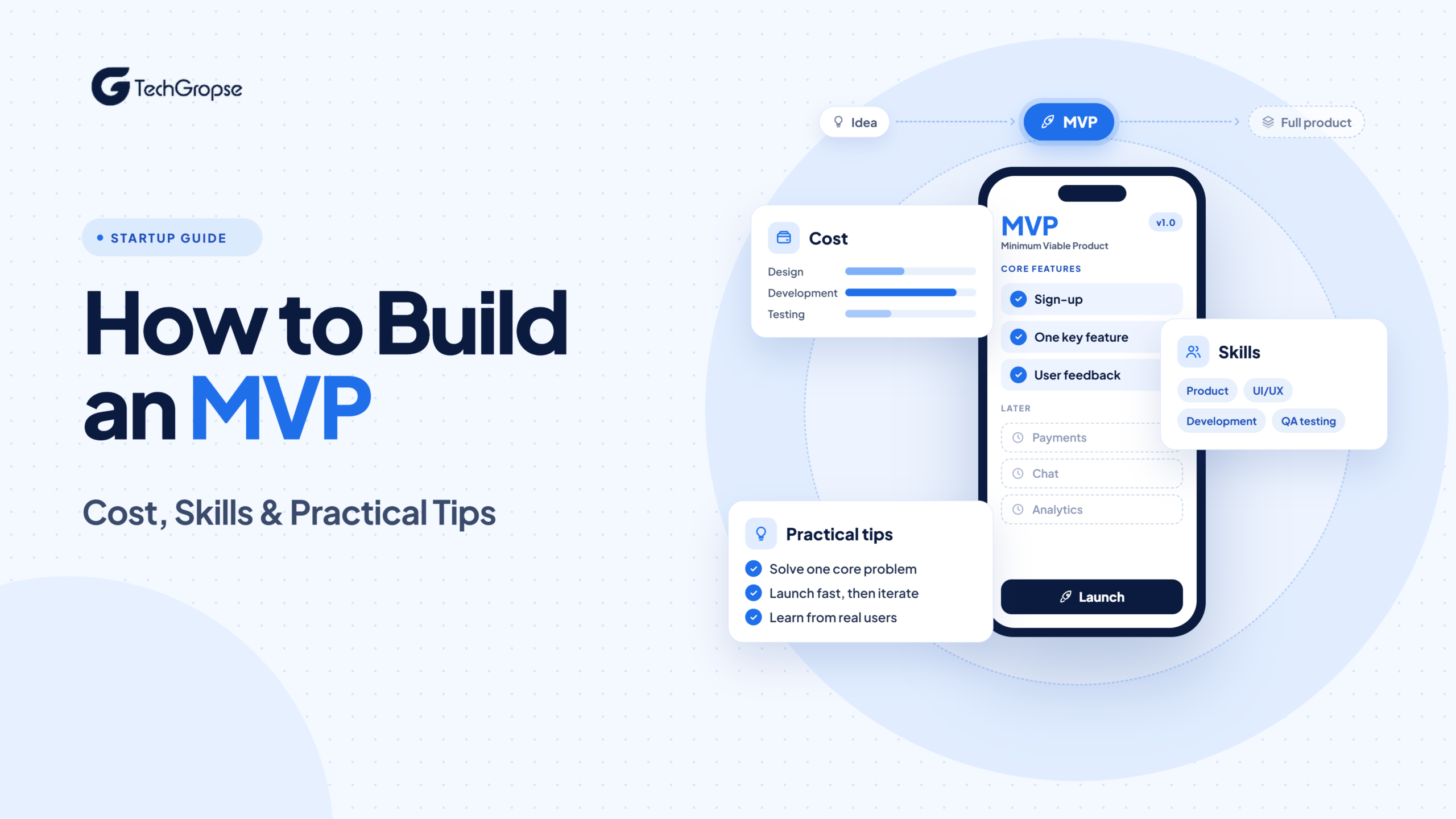
An MVP can be a sound investment even when it changes the original product plan. Customers may value one workflow far more than the wider idea, or use the product without being willing to pay for it. Learning that early gives leadership a chance to redirect the budget while there is still room to act.
For UK businesses, this makes choosing an MVP development company a commercial decision. Before the build begins, both sides should agree what the release needs to test, what would justify further investment and which security and compliance requirements must shape the scope.
This guide explains how to build an MVP around those priorities, covering the development process, team skills and factors shaping MVP development cost. Each deserves attention because the first release will influence what the business commits to next.
Your First Release Should Give You a Reason to Invest in the Second.
We can help you assess your idea, prioritise essential features and plan an MVP around your business goals and available budget.
Discuss Your MVP Project
What is a Minimum Viable Product (MVP)?
A minimum viable product (MVP) is an early version of a product that delivers enough value for a defined audience to use it and provide meaningful feedback.
Consider a founder developing booking software for independent fitness instructors. The eventual platform might include memberships, marketing automation, recommendations and several payment options.
The first release could allow an instructor to publish available sessions and let customers book them. That creates an opportunity to investigate a useful question: will instructors and their customers adopt this booking process?
The booking still needs to work reliably. Customers must know whether their place is confirmed, and instructors need an accurate attendance list. Those details are essential to delivering the promised value.
Minimum viable product development involves deciding which capabilities belong in that complete first experience and which can wait until the business has more evidence.
It also helps to distinguish an MVP from the work that may come before it.
| Approach | Main Question | Booking Product Example |
|---|---|---|
| Proof of concept | Can the proposed technology work? | Test whether an external calendar can exchange availability reliably |
| Prototype | Can people understand and use the proposed experience? | Let instructors try a clickable booking flow |
| MVP | Will people use the product in practice? | Launch a working booking service with a small group of instructors |
These approaches serve different purposes. A technical experiment or usability test may resolve an important uncertainty before the team commits to a live release.
Why Should Startups Invest in MVP Development?
The value of MVP development for startups lies in improving the next investment decision.
Before launch, a founder might believe customers need more flexibility. Actual usage could show that they mainly want fewer steps. Those findings lead to different development priorities, budgets and product roadmaps.
A focused first release can help a business:
- Test Demand: Find out whether a problem matters enough for customers to change their behaviour.
- Prioritise Spending: Direct development towards needs supported by actual usage and feedback.
- Explore Willingness to Pay: Assess whether the value delivered supports a workable price.
- Understand Operating Costs: Discover how much support and manual effort each customer requires.
- Support Funding Discussions: Give prospective investors evidence of customer behaviour and early commercial progress.
There is also value in discovering that an assumption was wrong. If customers will not adopt the proposed workflow, learning that while the product is small can prevent a much larger commitment.
Custom Tip from TechGropse:
Agree on this before development begins. Otherwise, the pressure to present the launch as a success can make inconvenient feedback easy to dismiss.
How to Build an MVP: A Step-by-Step Development Process
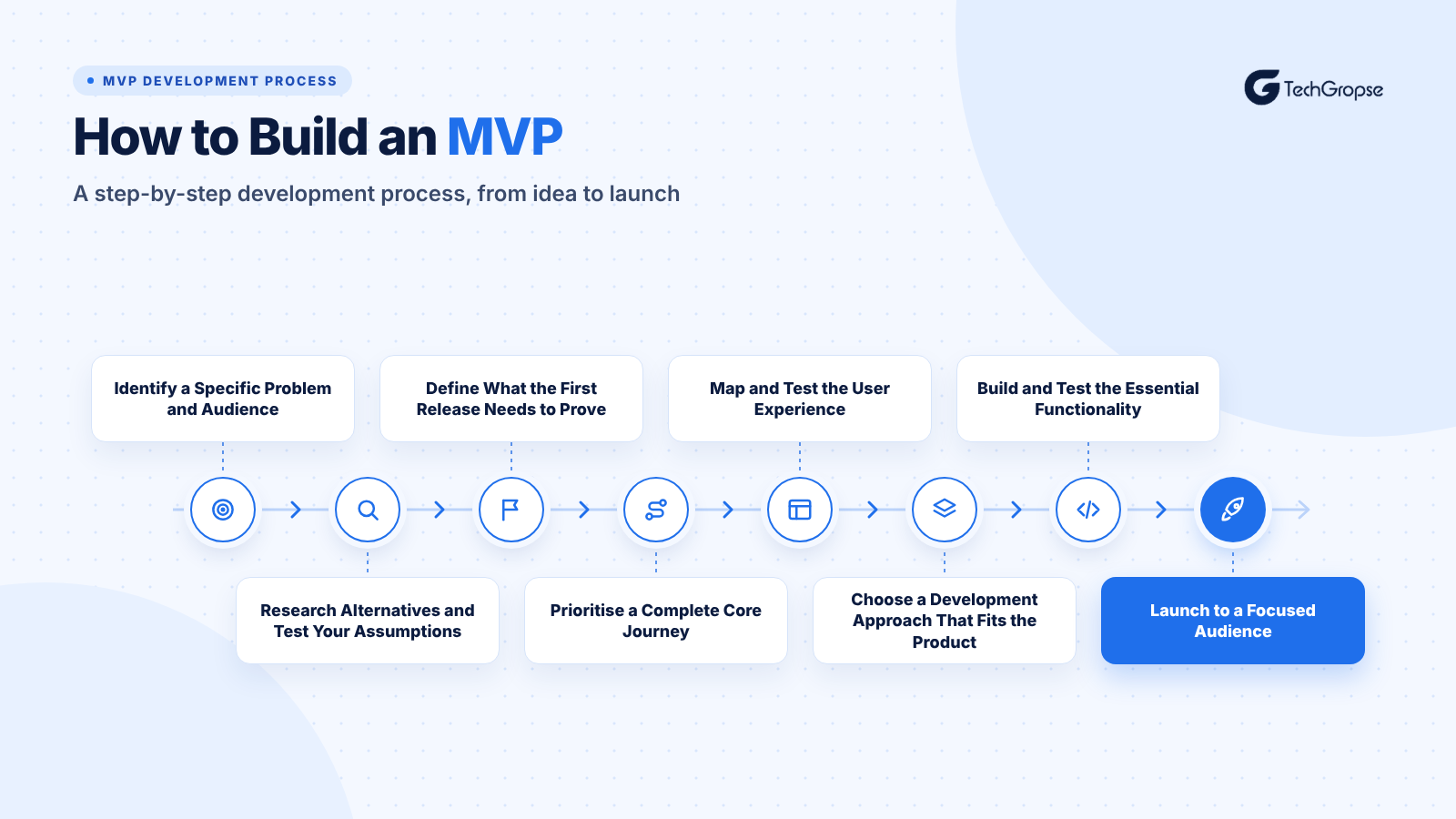
A useful MVP development process connects delivery work to the questions the business needs to answer. Each stage should leave the team better informed about the product, its customers or the effort required to serve them.
Identify a Specific Problem and Audience
Start with a situation your intended customers already experience.
For a booking product, “help fitness businesses grow” is too broad to guide development. A more useful starting point would be independent instructors who arrange group sessions through messages and repeatedly chase booking confirmations.
Speak to those instructors about recent experiences. Ask how they managed their last cancellation, where attendance records live and what happens when a class fills up.
Specific examples reveal the work your product would need to replace. They also help distinguish a recurring problem from an occasional inconvenience that customers are happy to tolerate.
Research Alternatives and Test Your Assumptions
Your competition includes whatever customers currently use: spreadsheets, messages, existing software or an employee who manages the process.
Understand why that approach persists. It may be inexpensive, familiar or flexible in ways your proposed product is not.
Then identify the assumption most likely to undermine your idea. Perhaps instructors like online booking but are unwilling to maintain another calendar. A pilot using existing tools could investigate that before you develop a scheduling system.
The UK Government’s Service Manual applies similar reasoning during its alpha phase, encouraging teams to test risky assumptions through focused experiments. Although an alpha differs from a live commercial MVP, the principle is useful: investigate major uncertainties while changes remain relatively inexpensive.
Define What the First Release Needs to Prove
Turn the product idea into a clear learning objective.
For example:
Independent instructors will use the service for recurring classes because it reduces the time they spend managing bookings.
That statement suggests what to measure: whether instructors publish further sessions, whether customers complete bookings and whether administration takes less time.
Agree on a suitable pilot period and the findings that would justify another investment. Those expectations should reflect how frequently customers need the product and how the business intends to earn revenue.
Set success criteria before the results arrive. Registrations can look encouraging even when very few users complete the task the product was built for.
Prioritise a Complete Core Journey
Map the steps a customer must take to receive the promised value. Then identify the functionality needed to support them.
For the booking example:
| Include in the First Release | Consider After Validation |
|---|---|
| Instructor creates a session | Multi-location management |
| Customer views availability | Personalised recommendations |
| Customer makes a booking | Loyalty programme |
| Both parties receive confirmation | Advanced marketing automation |
| Instructor manages cancellations | Detailed revenue forecasting |
The exact scope depends on the business question. Payments belong in the MVP if the main objective is to test paid bookings. They may be unnecessary for a pilot focused on attendance management.
A helpful test for each feature is whether removing it would prevent the customer from completing the core task or prevent the business from learning something essential.
Map and Test the User Experience
Create wireframes or a clickable prototype before committing to detailed development.
Ask prospective users to complete realistic tasks without guiding them through every screen. Can an instructor publish a session? Does a customer understand whether a booking succeeded? Can either person find the cancellation information?
Pay attention to hesitation and workarounds. Someone saying the design looks good tells you less than watching them struggle to complete a booking.
Use these sessions to simplify language, remove unnecessary fields and resolve confusing steps. The aim is to identify avoidable friction before it becomes part of the working product.
Choose a Development Approach That Fits the Product
Platform choice should follow the audience and the requirements of the experience.
A responsive web application may suit a booking service accessed through shared links. A mobile application may be appropriate when device capabilities or frequent mobile interactions are central to the product.
For MVP app development, compare native and cross-platform approaches against actual requirements, including device access, testing, performance and maintenance.
No-code tools can also support early validation. Assess their limitations around integrations, data access, pricing and migration before relying on them.
Ask the technical team to explain the trade-offs. The approach should support the first release while leaving a reasonable path for the changes you are most likely to make next.
Build and Test the Essential Functionality
Develop in small increments so the team can review working journeys throughout the project.
Testing should cover ordinary use and situations that go wrong. What happens when two customers request the last place? Can someone book twice? Does a failed confirmation leave the instructor uncertain about attendance?
Security and data handling also need attention during the build. The ICO’s guidance requires organisations subject to the relevant UK GDPR obligations to consider data protection from the design stage and throughout the lifecycle. That includes deciding which personal information is necessary, who can access it and how long it should be retained.
A limited feature set reduces scope. The responsibilities associated with serving real users still apply.
Launch to a Focused Audience
Choose early users who resemble the customers you intend to serve. Friends and colleagues can identify obvious problems, but their encouragement may not reflect market demand.
Give users a straightforward way to report issues. Assign someone to investigate failures, review feedback and speak to people who stop using the product.
Plan how you will reach these users before the launch date. A working application without a practical recruitment plan can leave the team waiting for evidence that never arrives.
Keep enough delivery capacity available to respond once customers begin using it.
How Much Does It Cost to Build an MVP in the UK?
For initial planning, MVP development cost in the UK can fall around £10,000-£30,000 for a focused web application, while more involved SaaS or cross-platform builds may require £25,000-£65,000. Advanced AI-powered platforms can reach £110,000 or more.
These are indicative budgeting ranges rather than fixed prices or market averages. The categories overlap because different products require different levels of engineering.
| MVP Category | Indicative Budget | Scope to Clarify Before Requesting a Quote |
|---|---|---|
| Focused web MVP | £10,000-£30,000 | Core workflow, user accounts, administration and design requirements |
| Mid-complexity SaaS or cross-platform MVP | £25,000-£65,000 | User roles, business rules, integrations and supported platforms |
| Advanced AI-powered MVP | £110,000+ | Data preparation, AI evaluation, integrations and operational controls |
To understand how much it costs to build an MVP for your business, look beyond the headline figure. Simply put, the MVP development cost in the UK depends on the work behind each feature. Adding a user role, supporting another platform or connecting to an existing system can increase the time needed for design, development and testing without adding much to the visible feature list. Let’s look into the major factors that impact the overall cost:
Product Scope and Feature Complexity
A booking request that an instructor approves manually might need a form and a confirmation. Live booking adds work to keep availability up to date and prevent two customers from reserving the same slot. Waiting lists, recurring sessions and refunds each add rules the development team has to implement and test.
User roles affect the estimate in the same way. Giving an administrator the ability to approve refunds, for instance, adds screens, permissions and tests to check that only authorised staff can issue them.
Platforms and Third-Party Integrations
A responsive web MVP gives the team one application to build and release. Separate native apps for iOS and Android add platform-specific development, device testing and app store submissions. A shared codebase can reduce some of the development work, with testing still needed on both platforms.
Integrations add cost when the team has to do more than connect two systems. An older scheduling tool might require developers to reconcile inconsistent records, work around limited API access and handle failed updates. Access to a test environment also affects how early the team can verify the connection.
Team Structure and Delivery Responsibilities
The quoted MVP development cost depends on which responsibilities the proposal covers. If the fee covers engineering alone, the business still needs someone to define requirements, review technical decisions, test the software and manage deployment. Doing that work internally takes staff time. Hiring people to cover it adds fees and coordination. Compare proposals based on what each team will deliver through launch.
Costs After Launch
Hosting and software subscriptions continue while the MVP is live. Usage-based fees for services such as messaging, payments or AI can rise as customers use the product more. The pilot also needs a budget for recruiting users, supporting them and making changes based on what they do.
Check which third-party fees sit outside the build quote and how long the agreed support period covers defect fixes. Budget separately for improvements that come out of the pilot, so the team can act on what it learns.
How to Get an MVP Development Quote in the UK
Two quotes for a booking MVP can cover quite different launches. One might cover a private pilot where fitness instructors confirm reservations by hand. Another might cover a public release where customers pay online and can request refunds when a class is cancelled. Before approving either estimate, the business needs to know what customers will actually be able to do on launch day.
What to Share Before Requesting a Quote
A short brief is enough to begin. Describe who the product is for, the problem it solves and the one task the first release needs to support. Mention any systems it must connect to and any budget or launch date the project needs to work around. If a prototype already exists, explain which parts have been tested with users and which are still open to change.
What the Proposal Should Cover
Look for a proposal that describes the release in plain language. For the booking MVP, that might mean inviting five instructors to publish classes and accept reservations, with online payments planned for a later phase. Defining the release at that level makes it clear what the team is pricing and what would count as a completed build.
The proposal should also show the cost in pounds, state whether VAT is included where applicable, and identify any ongoing charges outside the build estimate. Before signing off, clarify what launch support covers and who will own the source code and control the hosting accounts after handover.
Have a First Release in Mind?
Share a short project brief to discuss what can fit your budget and get an estimate based on the release you intend to launch.
Request an MVP Estimate
What Skills and Team Do You Need for MVP Development?
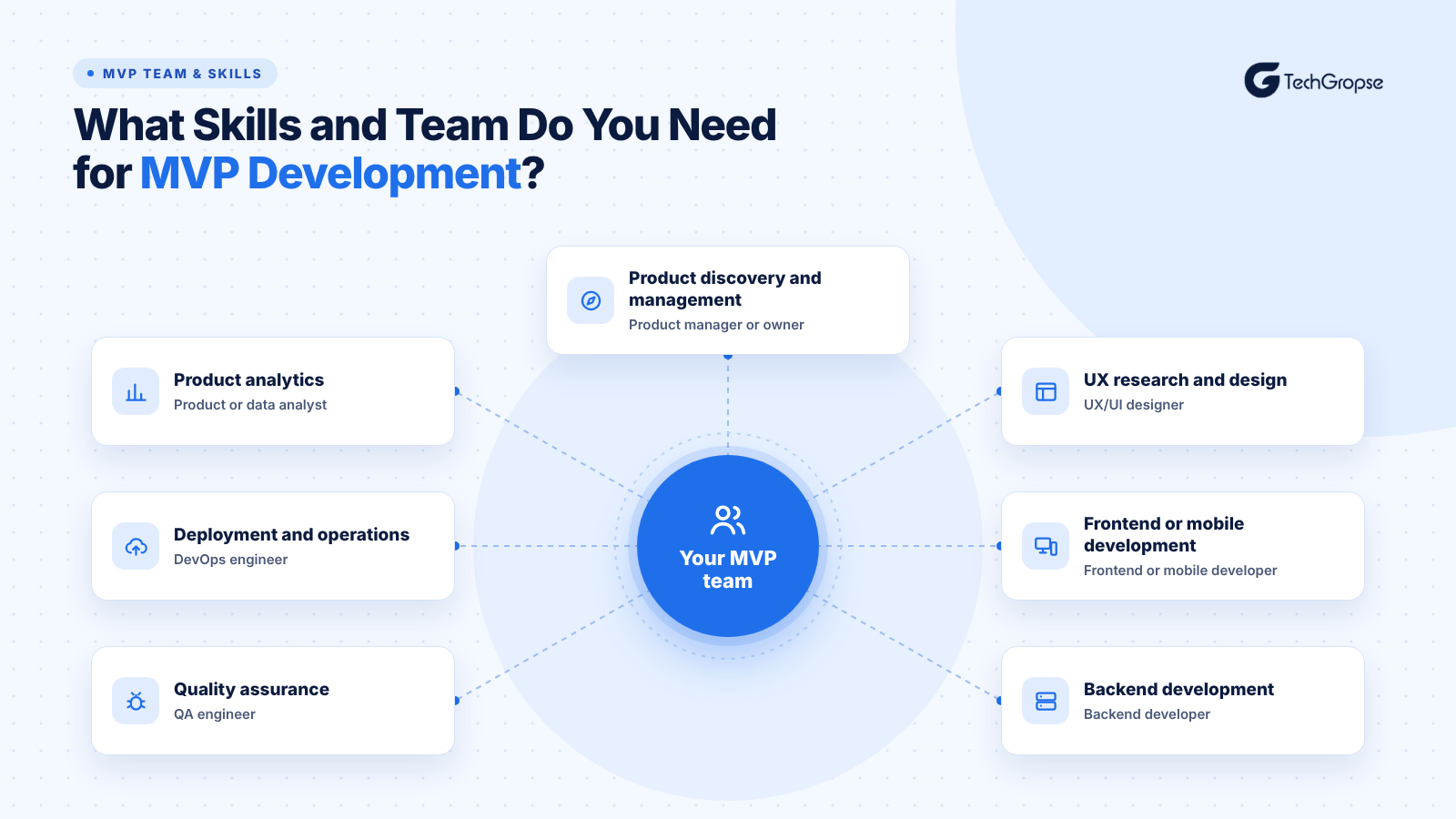
A small team can deliver an MVP when the important responsibilities are covered. Some people may take on more than one role, depending on the scope and their experience.
| Skill or Responsibility | Contribution to the MVP |
|---|---|
| Product discovery and management | Defines the problem, priorities and success criteria |
| UX research and design | Tests the journey and makes the core task understandable |
| Frontend or mobile development | Builds the interface customers use |
| Backend development | Handles business rules, data and integrations |
| Quality assurance | Checks workflows, failure cases and release readiness |
| Deployment and operations | Manages environments, monitoring, releases and recovery |
| Product analytics | Helps the team interpret usage and evaluate results |
Choosing Between an In-House Team, Freelancers and an Agency
An in-house team offers direct involvement but needs the capacity and skills to deliver the project alongside other commitments.
Freelancers can suit clearly defined work, particularly when the business already has someone capable of coordinating delivery and reviewing quality.
A development company may provide several disciplines through one engagement. But, before finalizing a firm, a business must examine who will actually work on the project, how decisions are made and what happens if a key team member changes.
Ask prospective partners which part of your proposed scope they would challenge. Their reasoning can reveal more about their suitability than a long list of technologies.
How Long Does MVP Development Take?
A focused MVP may be planned around a six-to-twelve-week delivery window, but the suitability of that timeframe depends on scope, integrations, team availability and approval requirements. It should be treated as an initial reference rather than a guaranteed schedule.
A useful project plan identifies the conditions each stage must meet.
| Stage | What Needs to Be Resolved |
|---|---|
| Discovery | Target audience, core problem, initial scope and success criteria |
| Design | Main journey, usability issues and decisions requiring approval |
| Development | Working functionality, business rules and essential integrations |
| Testing and launch | Critical defects, deployment, monitoring and user support |
| Pilot and review | Enough actual usage to assess the original assumptions |
Some activities can overlap. Others depend on access, approvals or earlier technical decisions.
There are also two dates worth distinguishing: when the first release becomes available and when the business will have enough evidence to evaluate it.
A product used monthly needs a different observation period from one used several times a day. Build that learning period into the plan.
UK Compliance Requirements That Shape MVP Scope and Cost
An MVP can have a small feature set and still carry significant responsibilities. Handling personal information, tracking user behaviour or providing a regulated service can introduce requirements that affect architecture, testing and launch readiness.
For businesses commissioning MVP development in the UK, these requirements belong in the initial scope. A proposal that leaves them unexplored can underestimate both the work involved and the budget needed to reach a live release.
UK GDPR and Data Protection by Design
When an MVP processes personal information, data protection influences how the product is designed and operated. Relevant decisions include which information is collected, how access is controlled, how long records are retained and how users can exercise their rights.
The ICO requires data protection to be considered from the design stage and throughout the lifecycle. Depending on the processing involved, this can translate into requirements for permissions, deletion workflows and privacy controls. These are development considerations that need to be understood before the scope is finalised.
PECR Requirements for Tracking and Marketing
Analytics tools, advertising technologies and email campaigns can introduce obligations under the Privacy and Electronic Communications Regulations, or PECR.
The requirements depend on the technology and its purpose. Some storage and access technologies qualify for exceptions, while others require consent before activation. This affects how analytics and third-party tools are integrated, what information users receive and which controls the interface needs. An MVP’s measurement plan should account for these conditions from the outset.
Accessibility and Customer Access
Accessibility can affect whether customers can register, navigate the product and complete its core task. Relevant design and testing considerations include keyboard navigation, readable contrast, labelled forms and understandable error messages.
UK service providers have reasonable-adjustment duties under the Equality Act 2010, or the Disability Discrimination Act 1995 in Northern Ireland. Public-sector websites and applications face additional accessibility requirements, subject to applicable exemptions. The intended users and deployment context therefore influence the accessibility work included in an MVP engagement.
Sector-Specific Requirements for Financial and Health Products
A product’s actual function determines which sector requirements need examination. A fintech MVP involving regulated activities may require FCA authorisation or registration. Health software may fall within medical-device requirements depending on its intended purpose and claims.
These distinctions can affect the permissible pilot scope, documentation and launch schedule. A limited release does not, by itself, remove applicable obligations. Establishing the regulatory position early gives the development team a clearer basis for estimating and planning the work.
For buyers comparing development proposals, the commercial question is whether the estimate includes the work required for the intended launch. Clearly defined responsibilities, controls and review requirements make the budget more useful and reduce the risk of discovering essential work shortly before release.
Practical Tips to Build an MVP Without Wasting Your Budget
The process provides structure. The following decisions help protect it when new requests and competing priorities appear.
Test Expensive Uncertainties Early
Investigate a critical integration or unfamiliar technical requirement before building the surrounding experience.
For an AI-enabled product, test whether the proposed approach produces useful results on representative data before investing in a polished interface.
Discovering a fundamental limitation early leaves more options available. You can change the approach, narrow the scope or reconsider the feature before it absorbs a substantial part of the budget.
Reuse Standard Capabilities Carefully
Existing services can reduce development work for functions such as authentication, messaging and payments.
Check ongoing fees, data access, operating limits and migration options before choosing them. A component that saves time during development may become expensive as usage grows.
Custom engineering is most valuable where the product needs to behave differently or where existing services cannot meet an important requirement.
Give Feature Requests a Clear Decision Rule
New ideas will appear during development. Record them, then assess whether they are necessary to complete the core task or investigate the original assumption.
Agree on who can approve a change and how its effect on cost and timing will be assessed.
This prevents individually reasonable additions from quietly reshaping the project. It also gives stakeholders a clear explanation when a useful idea is scheduled for a later release.
Make Manual Work Visible
Some early products can use manual operations behind the scenes while demand is being tested.
Record that effort. If every booking requires substantial intervention, apparent customer demand may conceal an expensive operating model.
Manual work can help the business learn, but it should be included when assessing the cost of serving customers. Track which activities would eventually need automation and why.
Protect the First Round of Improvements
Reserve time and money for changes after launch.
Early users may expose a confusing onboarding step, an important exception or a problem with the offer itself. These findings become useful when the team can act on them.
Several weeks of unresolved issues can also distort the evidence. It becomes difficult to tell whether customers rejected the idea or simply encountered an experience that did not work well enough.
How Do You Know Whether Your MVP Is Working?
Start with the behaviour your product was designed to encourage.
For the booking example, registrations indicate initial interest. Published sessions, completed bookings and instructors returning the following week provide stronger evidence of adoption.
A practical review combines several measures.
| Measure | What It Helps You Understand |
|---|---|
| Completion of the core task | Whether users can obtain the intended value |
| Repeat usage | Whether that value remains useful over time |
| Paid conversion, where relevant | Whether customers will make a financial commitment |
| Support effort | How much assistance the experience requires |
| Reasons for abandonment | Whether problems concern usability, relevance, price or trust |
Interpret the figures alongside conversations with users. Low repeat usage might reflect an awkward experience, weak demand or a task that naturally happens infrequently.
Small samples also require care. One enthusiastic customer can provide valuable insight without establishing a repeatable market.
The review should produce a decision. You might improve onboarding, investigate a different customer group, adjust the proposition or expand the product cautiously. You may also decide that further development is not justified.
The strongest outcome is a clearer understanding of what deserves investment next.
How TechGropse Can Help You Build Your MVP
We hope this blog has given you an initial insight into “how to build an MVP”. Now, businesses must understand that a productive development partnership brings structure to the early choices: which workflow to build, what can wait and how the first release will be evaluated.
At TechGropse, our MVP development services in the UK bring together design, development, testing and deployment to support a focused first release. The approach starts with understanding the product’s requirements and the experience it needs to deliver.
Bring your customer problem, current evidence and budget to the discussion. These provide a starting point for defining essential functionality, examining technical options and planning delivery.
Our goal is to deliver you a scope you understand, assumptions you can challenge and a product you can put in front of the right users.
Frequently Asked Questions
Yes. Some ideas can be tested using no-code tools or a service supported by manual operations. Suitability depends on the experience you need to validate. Assess integrations, data handling, operating costs and platform limitations before committing.
There is no fixed number. Include the functionality needed for the target user to complete the core task and for the business to assess its assumptions. A booking product may need several connected functions to make one customer journey work reliably.
Choose based on how customers will use it. A web application may suit a service accessed through links or desktop workflows. A mobile application may be appropriate when device features or frequent mobile interactions are central to the experience.
An MVP can provide evidence about demand, usage and willingness to pay. Investors will also assess the team, market, business model and growth potential. A working product strengthens the discussion when its results support a credible commercial case.

Saurabh Singh is a Senior Enterprise Content Writer at TechGropse, specializing in translating complex technologies into clear, insightful, and business-focused content. His expertise spans enterprise technology, software development, AI-driven solutions, and digital transformation, with a focus on connecting technical capabilities to real-world business objectives. He has contributed to content initiatives for TechGropse clients such as Home101, Artera, Peekabox, and Zayed University, bringing their products, services, and technological offerings to life through strategic storytelling. His work involves simplifying complex concepts, communicating software value propositions, and translating emerging technology trends into meaningful narratives for business leaders, decision-makers, and end users. Through a blend of technical understanding and business-oriented communication, he makes complex solutions accessible, relevant, and valuable to diverse audiences.