 +447413083355































A lower development quote is easy to defend in a budget meeting. The cost of rebuilding an unreliable app six months later is much harder to explain.
That is the challenge with hiring app developers in the UK. The price is visible before you sign. The quality of technical decisions, the reliability of the team and the effort required to maintain the product become clear over time.
For business leaders, a sound hiring decision starts with looking beyond the promised launch. Can this team build an app that fits your operations, handles customer expectations and remains manageable as requirements change?
The following eleven mistakes reveal where that assessment can go wrong and what to establish before your business commits.
Your App Budget Should Move the Business Forward
We help turn business requirements into a practical development scope, with the platforms, integrations and delivery priorities considered from the start.
Discuss Your App Project
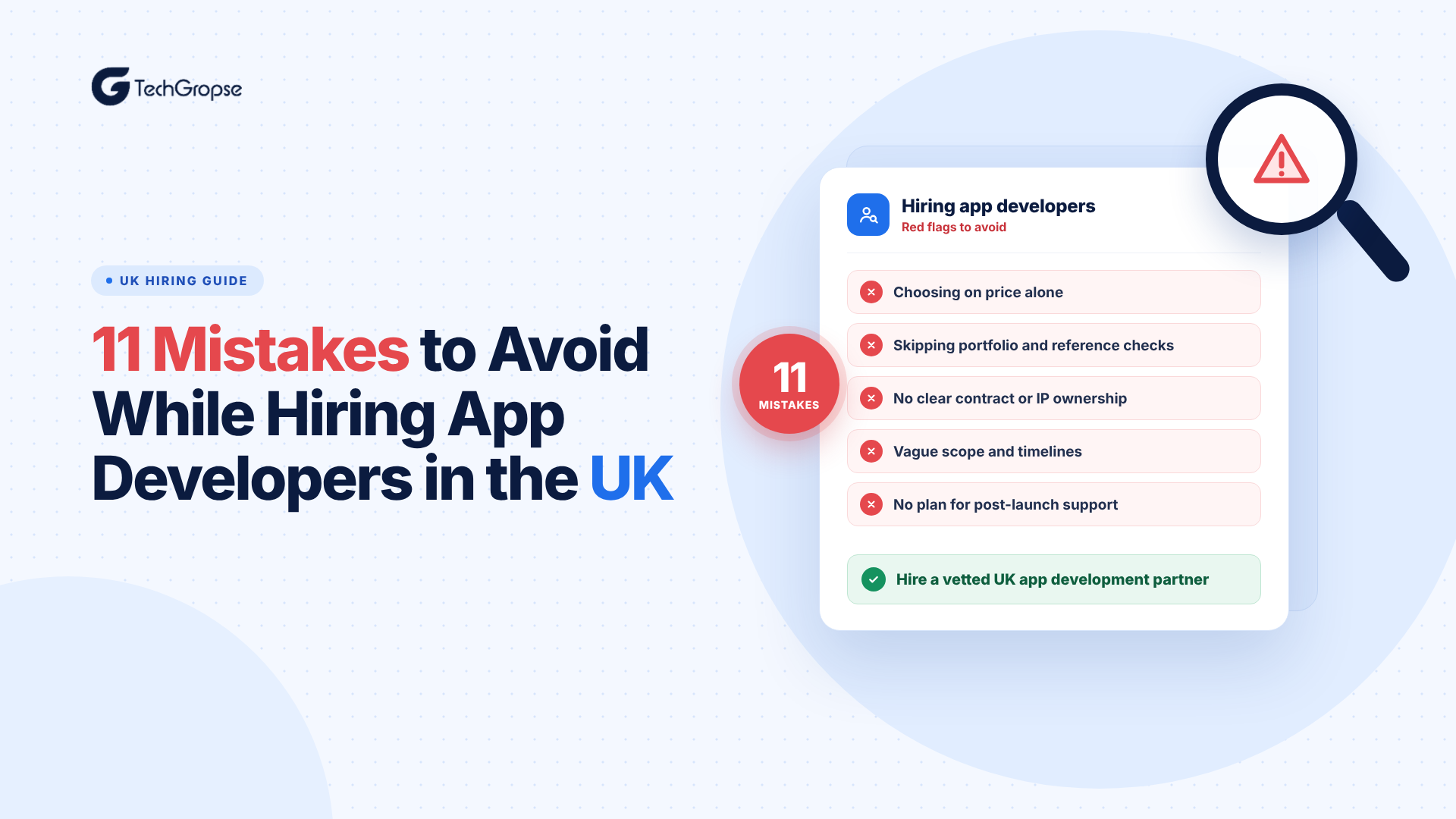
Mistakes Businesses Need to Avoid When Hiring App Developers in the UK
A development partner influences your costs, customer experience and ability to improve the product. These app developer hiring mistakes can leave your business paying for gaps that should have been addressed before work began.
1. Hiring Before Defining What the App Must Achieve
A project can deliver every requested feature and still leave the original business problem unresolved.
Suppose a distributor commissions a customer ordering app to reduce administrative work. If orders still need to be re-entered into its existing system, the new interface may create another channel for staff to manage.
Before requesting proposals, define the outcome the app should support. That could mean reducing manual order processing, helping customers complete bookings or giving field teams access to accurate information.
A capable development partner should investigate the processes behind those outcomes. Its questions about users, systems and operational constraints will tell you how well it understands the work.
2. Comparing Prices Without Comparing Scope
Two development firms can quote for the same app while pricing different levels of responsibility.
One may include interface design, backend development, integrations, testing and deployment. Another may assume your business will provide approved designs and functioning APIs. The difference may remain unnoticed until additional invoices arrive.
When comparing app development companies in the UK, review the work covered by each proposal. Check revision allowances, third-party charges, integration assumptions and launch responsibilities.
Ask each firm to explain what could change its estimate. A proposal that identifies uncertainty gives you a better basis for budgeting than a fixed number with unclear exclusions.
3. Choosing a Portfolio Without Checking Relevant Experience
An impressive interface provides limited evidence of how an app performs under real operating conditions.
A team may have built attractive retail apps without handling the challenges of a workforce application that needs to function with poor connectivity. Similarly, experience building a simple checkout does not automatically demonstrate expertise in subscriptions, refunds and payment reconciliation.
Ask about a project with comparable technical or operational demands. Establish exactly what the firm delivered and which decisions its team owned.
A useful reference conversation should cover how the developers handled changing requirements, difficult releases and support after launch. Those details help you assess the relationship your business is likely to experience.
4. Evaluating the Sales Team Instead of the Delivery Team
The technical confidence you encounter during procurement needs to carry through into delivery.
Before signing, meet the people expected to lead engineering and project management. Discuss their experience, availability and responsibilities. Establish how much of the work will involve subcontractors and how team changes will be handled.
For mobile app developers in the UK working across several locations, clarify the hours available for joint decisions and urgent issues.
A named project manager is useful, but accountability also needs to extend to technical quality. Your business should know who reviews important engineering decisions and who takes ownership when a problem involves several parts of the product.
5. Accepting a Technology Choice Without Understanding the Trade-Offs
A development firm’s preferred technology can shape your maintenance costs long after the initial contract ends.
The recommendation should follow the app’s requirements. Device capabilities, background processing, expected usage and connections to existing systems can all influence whether native, cross-platform or another approach is suitable.
Ask the team to explain where its proposed approach works well and where extra development may be needed. Discuss how easily another team could maintain the product and whether any proprietary components create ongoing dependence.
When choosing an app development company, look for the ability to explain technical decisions in terms your business can evaluate. You need to understand the consequences before approving the approach.
6. Treating Security and Data Protection as Final Checks
Security requirements can affect account access, data storage, integrations and administrative permissions. Leaving them until the end can create expensive changes across an otherwise completed app.
During supplier assessment, ask how the team will identify sensitive information, restrict access and test relevant controls. Clarify whether developers need live customer data and how access will be removed when their involvement ends.
If a company processes personal data on your behalf, appropriate terms are required. These should address matters including instructions, confidentiality, security and subprocessors. A general assurance that an app will be “GDPR compliant” does not describe those responsibilities.
7. Leaving Accessibility Out of Design and Testing
A customer who cannot read an error message or complete a form may abandon the transaction before your team understands the problem.
Accessibility should influence interface design and acceptance testing. Ask how the supplier tests screen-reader navigation, text enlargement, focus behaviour and essential customer journeys.
UK service providers have reasonable-adjustment duties under the Equality Act 2010, or the Disability Discrimination Act 1995 in Northern Ireland. Public sector websites and apps have additional requirements, subject to their scope and exemptions.
Agree the applicable requirements and testing responsibilities before pricing is finalised. That gives the team room to address accessibility throughout development and reduces the likelihood of late redesign.
8. Assuming the Contract Gives You Complete Ownership
Paying for an app does not automatically resolve ownership of its code, designs and supporting materials.
UK guidance explains that the creator will usually initially own copyright in commissioned work unless otherwise agreed in writing. The contract therefore needs to address ownership explicitly.
Clarify which project-specific assets will transfer to your business and which components are licensed. Check access to source repositories, hosting environments and app publishing accounts.
The practical question is whether another qualified team could take over without unnecessary disruption. Appropriate rights, current documentation and access to essential accounts all contribute to that freedom.
9. Approving a Timeline Without Agreeing What “Finished” Means
A feature working during a demonstration is one stage of delivery. Your business also needs confidence that it behaves correctly with real data, connected systems and foreseeable errors.
A payment journey, for example, should account for declined transactions, interrupted connections and duplicate requests. Those behaviours need to be included in the acceptance criteria.
Agree how completed work will be reviewed and how defects will be distinguished from new requirements. Identify client responsibilities that affect timing, including approvals and access to existing systems.
This makes progress easier to assess and gives both parties a clearer basis for resolving disagreements about completion.
10. Having No Internal Owner for Product Decisions
Outsourcing development still leaves your business responsible for deciding what matters.
Without a clear internal owner, developers may receive competing instructions from marketing, finance and operations. Work can be revised repeatedly while the underlying disagreement remains unresolved.
Assign someone who can consolidate feedback, involve the right stakeholders and approve priorities. That person should have enough authority and availability to keep decisions moving.
The development partner should explain the impact of proposed changes on cost, delivery and technical quality. Your internal owner can then decide whether the business value justifies the change.
This shared decision process is essential to keeping the project aligned with its original purpose.
11. Buying the Build Without Planning for Its Working Life
An app creates ongoing responsibilities once customers begin using it.
Operating system updates, third-party service changes and security maintenance can require further work. Customer feedback may also reveal improvements that were impossible to prioritise before launch.
Ask what support covers, when it is available and how urgent incidents are handled. Separate defect correction from maintenance and feature development so the commercial arrangement is clear.
Agree handover provisions as well. Documentation, account access, outstanding issues and transition assistance should be addressed while the relationship is positive.
Your business needs a plan for keeping the app useful and operational beyond the initial delivery.
Make the Difficult Decisions Before They Become Expensive Changes
We can help assess your app’s workflows, integrations and technical requirements, giving you a clearer basis for planning the build.
Talk Through Your Requirements
What UK Businesses Should Expect From an App Development Agreement
Once a development firm demonstrates the right capabilities, the agreement needs to reflect how your business actually operates. A UK address and a price in pounds provide only part of that picture.
Clear Commercial Terms
The proposal should make the financial commitment understandable to everyone approving it.
| Area | What to Establish | |||
|---|---|---|---|---|
| Contracting Entity | The legal entity responsible for delivery and issuing invoices | |||
| Currency and VAT | Whether pricing is in GBP and whether applicable VAT is included | |||
| Payment Milestones | The deliverables and review process associated with each payment | |||
| Additional Work | How changes are estimated, authorised and charged | |||
| Recurring Fees | Hosting, licences, support and other costs outside the build | |||
| Termination | Notice requirements, outstanding payments and handover responsibilities |
Where delivery involves more than one organisation, establish which party remains accountable to your business.
Visibility Into Overseas Data Access
A UK-based development partner may use development or support teams elsewhere. Understand that arrangement before granting access to personal information.
ICO guidance explains that making personal information accessible to a separate organisation outside the UK can constitute a restricted international transfer when the relevant conditions apply. Hosting the data on a UK server does not, by itself, resolve the issue.
Ask who will access the information, from which locations and under which arrangements. Appropriate transfer mechanisms and other relevant data protection obligations need to be considered for the actual delivery model.
Support That Matches Your Operating Hours
The support agreement should reflect when customers and employees depend on the app.
A hospitality business taking weekend bookings may need different coverage from an internal application used on weekdays.
Requirements Specific to Your Market
UK customers may need the app to handle local address formats, GBP transactions and daylight-saving changes correctly. Businesses in regulated sectors may also need specialist assessments or approvals that affect delivery.
Identify those requirements early, with named owners for any external review. The supplier should understand how they influence the product and the launch plan.
How to Hire App Developers in the UK With Greater Confidence
The final development team meeting should help you evaluate judgement under realistic conditions. Give shortlisted teams one important workflow from your project and ask how they would approach it.
| Ask the Team To Explain | What You Can Assess |
|---|---|
| The Most Uncertain Part of the Build | Whether it recognises dependencies and unanswered questions |
| The Information Needed Before Estimating | How carefully it investigates scope |
| A Relevant Technical Trade-Off | Whether recommendations follow your requirements |
| How a Difficult Release Was Handled | Its approach to accountability and communication |
| What Another Team Would Need for Handover | How it approaches documentation and client control |
The quality of the explanation matters. A strong team should be able to acknowledge uncertainty, describe how it would investigate it and explain the implications for your business.
That conversation can provide more useful evidence than another presentation of features and technology logos.
Why Choose TechGropse for App Development in the UK?
Your shortlist should include teams that can connect business requirements with the practical work of building and supporting an app. TechGropse is a leading development firm that builds iOS, Android and cross-platform apps with a clear commercial rationale behind the technology choice. We consider how customers will use the product, how it connects to your existing systems and what it will cost to maintain and extend, so your investment supports the business beyond launch.
Whether you are planning a customer-facing app or a tool for internal operations, we can discuss the workflows, platforms and connected systems the project needs to support. This helps establish a development scope that your stakeholders can assess.
Bring your idea, existing app or project brief. We can work through the requirements and discuss the proposed approach, dependencies and delivery priorities.
The aim is to give your business a clearer understanding of the work before it commits to development.
Have an App Project That Needs to Earn Its Investment?
Tell us what your business needs to achieve. We’ll help translate that objective into an app development scope and discuss the next steps.
Discuss Your ProjectFrequently Asked Questions
Assess relevant experience, the proposed delivery team, scope assumptions, testing approach and support arrangements. Confirm ownership, access to essential accounts and responsibilities for handling personal data before signing.
Freelancers can suit clearly defined work when your business already has technical leadership and delivery management. A development company can coordinate design, engineering and testing when you need those capabilities together.
Give suppliers the same brief and compare deliverables, assumptions and exclusions. Include ongoing fees and any work your internal team must provide. Clarify what could change the price before using the headline figure to make a decision.
A transition is easier when your business has appropriate intellectual property rights, source code, account access and current documentation. Agree handover responsibilities at the start. An incoming team will normally need to assess the product before estimating further development.

Saurabh Singh is a Senior Enterprise Content Writer at TechGropse, specializing in translating complex technologies into clear, insightful, and business-focused content. His expertise spans enterprise technology, software development, AI-driven solutions, and digital transformation, with a focus on connecting technical capabilities to real-world business objectives. He has contributed to content initiatives for TechGropse clients such as Home101, Artera, Peekabox, and Zayed University, bringing their products, services, and technological offerings to life through strategic storytelling. His work involves simplifying complex concepts, communicating software value propositions, and translating emerging technology trends into meaningful narratives for business leaders, decision-makers, and end users. Through a blend of technical understanding and business-oriented communication, he makes complex solutions accessible, relevant, and valuable to diverse audiences.